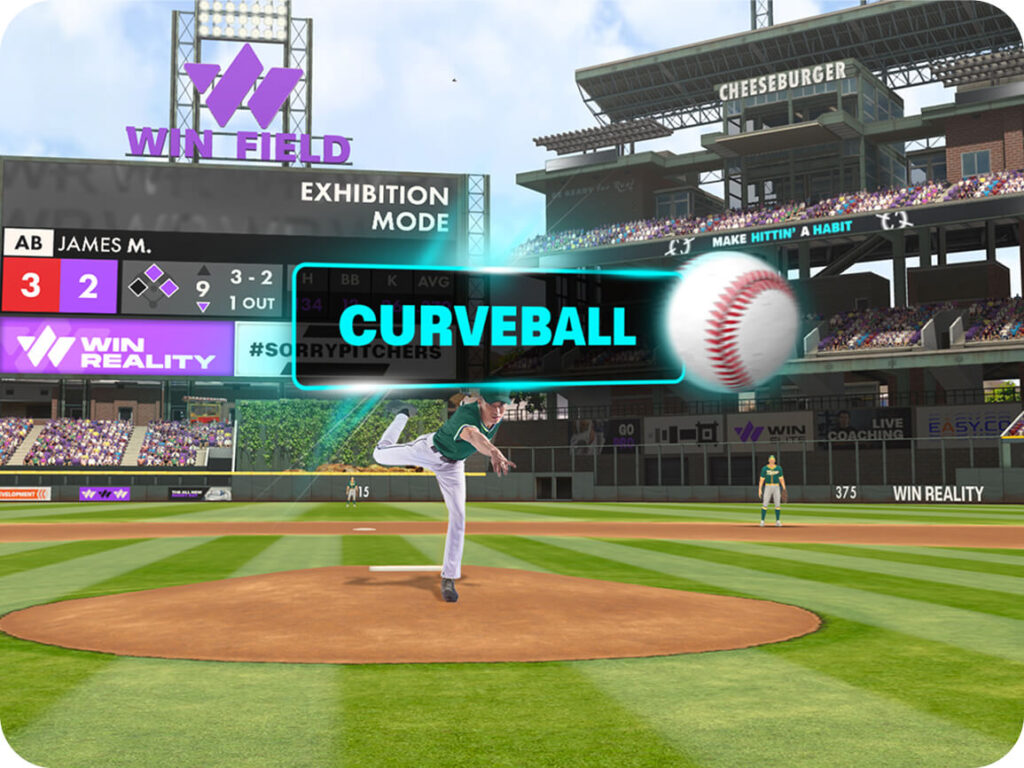
You’re in the box, 2-2 count, and the pitcher goes into his windup. You feel the slider coming, but when it breaks off the plate, you’re already committed. Swing and miss. That moment is where so many at-bats are decided.
Understanding what pitch recognition is in baseball and softball, and how to train it, is the difference between guessing and knowing. It’s the foundation of every quality at-bat, every two-strike adjustment, every walk drawn, every barrel found. WIN Reality built TrainVR around it for a reason.
This guide breaks down exactly what pitch recognition is, what separates it from related hitting skills, how the decision timeline works, and how you train it at game speed.
The Short Answer: What Pitch Recognition Means
Pitch recognition is a hitter’s ability to identify pitch type, velocity, and projected location early enough, typically within the first 20 feet of ball flight, to make a correct swing decision before the window closes.
Sports science classifies pitch recognition as a perceptual-cognitive skill, meaning it is vision-based but fundamentally mental. It centers on picking up cues in the pitcher’s wind-up, release, and the first 10–20 feet of ball flight. It is not simply tracking the ball to the plate. It is reading what the ball is going to do before it does it and committing to a decision with time left to execute.
What Pitch Recognition Actually Includes
A. Pitch Recognition vs. Pitch Tracking vs. Plate Discipline
These three terms get used interchangeably on the field. They are not the same thing, and confusing them leads to the wrong training fixes.
Pitch recognition is not pitch tracking. Visually tracking pitches to the catcher’s mitt is a natural action. Pitch recognition, focused on the pitcher’s motion, release point, and the first few feet of ball flight, is not natural and requires deliberate training.
Here’s how to separate all three:
- Pitch Recognition — Identifying pitch type, speed band, and likely location using pre-flight and early-flight cues. This happens in the first 0–125 milliseconds after the ball leaves the hand.
- Pitch Tracking — Following the ball’s path from the pitcher’s hand to the contact point with continuous focus.
- Plate Discipline — The decision layer: swing or take, based on what you recognized and where you predicted the ball would land. Better pitch recognition leads to better swing decisions, resulting in higher on-base percentage and slugging percentage.
Think of it as a chain: recognition feeds tracking, and tracking informs discipline. Break the chain at recognition, and everything downstream suffers.
B. The Hitter’s Decision Timeline
This is where most hitting instruction goes wrong. Coaches say “see the ball.” But you need to know when to see what — because each window in the timeline carries different information.
A 95 mph fastball takes around 425–450 milliseconds from release to the plate. It takes roughly 150 milliseconds to get the bat around. That leaves only tens of milliseconds in the middle to decide whether the pitch is worth swinging at.
Here’s how the timeline breaks down:
At Release (0–75 ms)
You face 75–100 milliseconds of neurological processing lag just to recognize an object moving toward you — before any identification or reaction begins. What you can read at release: arm slot, release height, hand angle, and the initial shape of ball separation from the hand.
Early Flight (75–175 ms)
This first 10–20 feet of ball flight is where pitch recognition actually happens. Spin axis, speed band, and initial trajectory become readable here. Elite hitters make their pitch-type call in this window.
Mid-Flight (175–300 ms)
Pitch shape and late movement develop here. You can confirm your early read or begin an abort sequence. The body needs roughly 25 milliseconds to translate a brain decision into physical movement, leaving approximately 100–200 milliseconds to execute a full swing.
Late Flight (300+ ms): Too Late
After accounting for processing lag and swing time, you have almost no time remaining to identify pitch type, location, and swing intent simultaneously. Hitters still reading the pitch here are guessing or getting beaten.
By training pitch recognition, you gain back those milliseconds so your swing can maximize rotation and bat speed. Anticipate pitch type from the game situation, confirm it with early visual perception, and your mechanics stay consistent.
C. The Cues Hitters Learn to Read
Pitch recognition training is cue-based. You aren’t guessing, you’re building a library of visual patterns that map to specific pitches. Here are the primary cue categories:
Pre-Release Cues
Arm slot and release height (high 3/4, sidearm, over-the-top)
- Grip flashes — some hitters pick up a “skinny wrist” look for the curveball; others detect more white or less hand thrust for the changeup
- Body language — some pitchers inadvertently show the baseball multiple times before delivery, visible behind the back and behind the head through to release
Spin and Shape Cues
- Tight backspin or sidespin signals fastball.
- Loopy, slower rotation with forward tumbling seams signals curveball.
- Tight, fast spin with a flat appearance signals slider or cutter. Less distinct, tumbling spin signals changeup.
Trajectory and Location Cues
- Initial pitch plane — does the ball start above or below the typical release window?
- Horizontal break angle in the first 10 feet
- Speed band — fastball vs. off-speed reads within the first 50–75 ms of flight
Research from sports vision specialists shows that elite hitters process visual information differently than average players. They’re not just seeing better, they’re processing what they see more efficiently. That includes the ability to quickly identify pitch types based on subtle cues like spin, release point, and trajectory.
How to Train Pitch Recognition
Method 1: Release-Point and Early-Flight Tracking
You’re late on everything, not because your bat speed is slow, but because you’re reading the ball too late. Start here:
The drill is simple: no swings. Stand in your stance during bullpen or batting practice and lock your focal point on the release window. Not the pitcher’s body, not the glove. As the pitcher begins their motion, fix your eyes on the specific spot where the ball will emerge. Your first job is to see the ball the instant it appears.
Run this drill for 10–15 pitches before any live swing reps. Force 3 consecutive correct early-read call-outs (fastball or off-speed) before you pick up a bat.
Progress marker: Can you call fastball vs. off-speed within the first 20 feet on 7 out of 10 pitches?
Method 2: Call-Out and Decision Drills
You’re swinging at breaking balls off the plate and taking fastballs down the middle. The problem isn’t plate discipline, it’s that pitch recognition never fires fast enough to inform the decision.
Turn bullpen tracking into a recognition drill by assigning a clear goal: call out “Yes” for fastball and “No” for any other pitch before the ball reaches the catcher’s mitt. When executing correctly, your eyes stay on the pitcher, not following the ball to the glove.
Build out the call-out structure:
- Type call-out — “Fastball,” “Curve,” “Slider,” “Change” — called by the time the ball crosses the midpoint of the mound-to-plate distance (approximately 30 feet)
- Ball/Strike call-out — “Ball” or “Strike” — called before the ball reaches the hitting zone
- Location call-out — “In,” “Away,” “Up,” “Down” — to build zone identification
- Swing/Take call-out — the full decision layer, combining type + location into an actionable read
The goal is forcing a recognition decision instead of automatically swinging at every pitch. Run 25–30 called pitches per session, 3–4 days per week, before moving into live swing reps.
Method 3: Game-Speed VR Recognition Reps
Here’s the problem with cage-only pitch recognition work: live pitchers throw 30–40 pitches in a bullpen session, and you share that time with multiple hitters. You might get 8–10 usable recognition reps. That volume isn’t enough to build the skill.
VR changes baseball training by giving you game-like reps without requiring a live pitcher, a full field, or physical wear from repeated swings. You can face a digital version of a known opponent, track a left-hander’s release height, recognize a slider shape, and make swing decisions in a controlled environment.
Because the software logs timing, chase rate, contact decisions, and visual behavior, you can see exactly whether you’re improving at the targeted skill, which is a major step forward from generic “see the ball better” advice.
The specific recognition skills you can isolate in a VR rep session:
- Pitch type identification — fastball vs. breaking ball vs. off-speed, called in real time
- Velocity band reads — distinguishing 88 mph changeup from 94 mph fastball by trajectory, not just speed
- Release-point variation — reading left-handed vs. right-handed arm slots across hundreds of reps
- Strike-zone discipline — swing/take decisions tied to live pitch location data
- Tunneling reads — identifying the break point where a fastball and curveball split from the same tunnel
Using a pitch simulation tool to face hundreds of pitches while measuring accuracy and speed improvement is exactly the volume and feedback loop that live reps alone cannot replicate.
How WIN Reality Helps: TrainVR for Pitch Recognition
Most hitters train their pitch recognition the same way every season: some BP, some bullpen stand-in, and whatever at-bats they get in games. The volume is low, the feedback is zero, and progress is left to chance.
WIN Reality’s TrainVR is a Meta Quest VR hitting simulator built specifically to fix that gap. You get access to 600+ virtual pitchers, game-speed reps from your living room, and a full pitch recognition training environment that runs whether or not you have a pitching coach, a bullpen, or a field.
TrainVR Pitch Recognition Drills — what you train and how:
- Pitch Recognition drill — Real-time identification of pitch type and location at game speed. Call the pitch before it hits the zone. Reps logged. Accuracy tracked.
- Release Point drill — Focused repetitions on reading the pitcher’s release window. Isolates the exact skill that dictates how early you get your read.
- Disappearing Pitch drill — The ball disappears at a set point in flight, forcing you to commit based on early-flight information alone. This is the pitch recognition pressure test.
- Recognition Window drill — Narrows the information window progressively, training your brain to read earlier with each session.
- Fastball/Curveball Tunneling scenarios — Game-realistic pitch sequences where two pitches share the same early flight path before breaking in opposite directions. The single hardest recognition challenge — available every session.
Beyond individual drills, TrainVR builds pitch recognition into scenario-based workouts: 3–2 count reads, 0–2 approach reps, 2-strike adjustments, breaking ball recognition sequences, and opposite-field intent work. Multi-week Training Tracks let you progress systematically rather than randomly picking drills.
The feedback loop is what separates VR from cage work. Because TrainVR logs timing, chase rate, contact decisions, and visual behavior, you can see whether recognition is actually improving — rep by rep, session by session.
TrainVR is available as a standalone subscription or bundled with SwingAI in the Ultimate Hitter Pack, which includes a WIN bat attachment, short bat and optional Meta Quest 3S headset. If you want both sides of hitting development — the recognition skill and the swing mechanics — the bundle is where to start.
Start Training Pitch Recognition with WIN Reality
Pitch recognition is the skill the game’s best hitters are never not working on. You now know what it is, when it fires, what cues drive it, and how to train it. The reps are waiting.
Get started with WIN Reality and start building game-speed pitch recognition with TrainVR — no pitcher required.