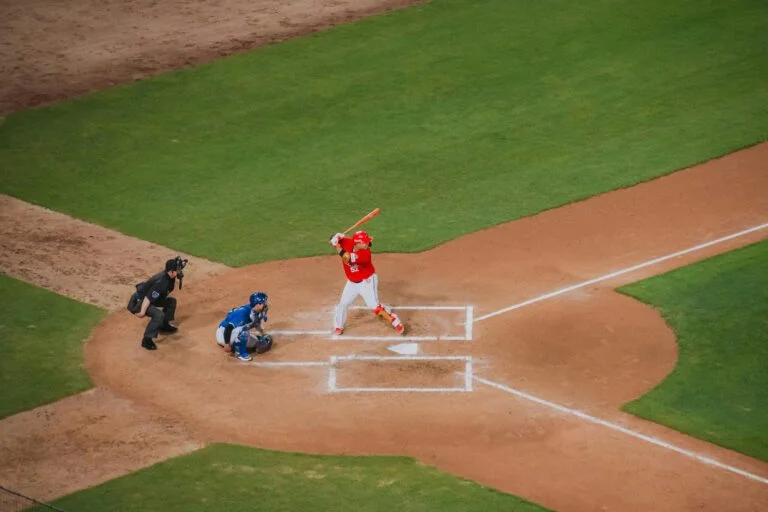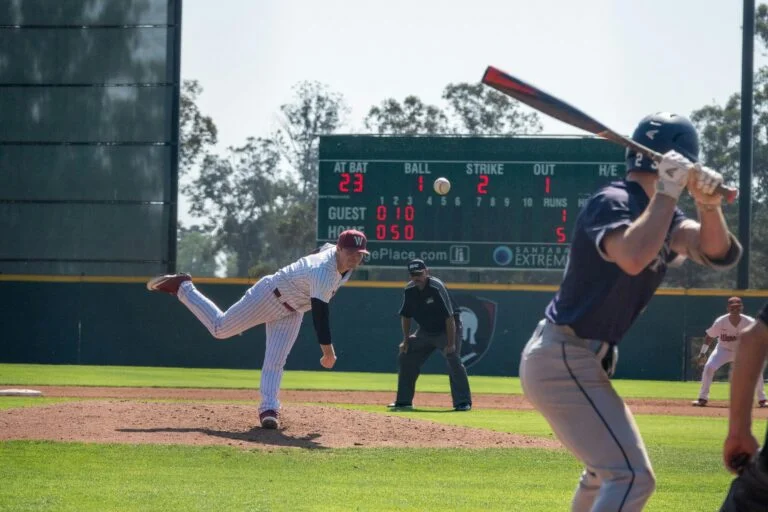
You step in against a pitcher throwing 90-plus, and the ball is on you before you can finish a thought. That is not a flaw in your focus. As neuroscientist Jason Sherwin, co-founder of the sports neurotech company deCervo, has explained: a 95-mile-an-hour fastball travels from release to the plate in around 425 to 450 milliseconds, and it takes roughly 150 milliseconds for a Major League Baseball player to get their bat around (NPR, 2016).
That math leaves you a sliver of time to read, predict, and commit. Pitch recognition is not guessing, and it is not raw reflex. It is a trained brain-body decision you can sharpen with the right reps, and this article breaks down exactly how that decision works and how to train it.
The Short Answer: How Does the Brain Decide Whether to Swing?
Your visual system reads the ball out of the pitcher’s hand, predicts where it is going, and your motor system either fires the swing or holds it, all in under half a second with almost no time for deliberate, step-by-step reasoning.
Here is the sequence your brain runs every pitch:
- Read the release. Arm slot, hand position, and early spin give you your first usable information.
- Predict the flight. Your brain projects trajectory and speed to classify pitch type and location.
- Decide go or no-go. A built-in inhibition system holds the swing on anything that reads “not a strike.”
- Execute the motor plan. Once you commit, the Kinetic Chain fires: Pelvis, Torso, Arms, Hands, Bat.
The big myth is that elite hitters “see the ball longer.” They actually predict earlier. EEG research comparing college-level baseball players to non-players found enhanced activity in motor-planning and inhibitory-control regions of the brain in the expert group (Muraskin, Sherwin & Sajda, 2015). There simply is not enough time in half a second for a conscious, weighed-out choice about whether to swing.
Train the read, not the overthink. That is the whole game.
The Brain Timeline of a Swing Decision
Picture an 0-1 count, a hitter sitting fastball, and the pitcher spins a slider. The hitter who flails was late on the read, not slow with the bat. To fix that, you have to understand the four stages your brain moves through between release and contact.
A. Release Cue Recognition
Everything starts the instant the ball leaves the hand. A batter uses visual cues to track trajectory, speed, and spin from the moment of release. You have roughly the first 100 milliseconds of flight to gather your most valuable information.
Your eyes are hunting specific cues at release:
- Arm slot and release point height
- Hand and wrist position at let-go
- Seam orientation and early spin signature
- The first few feet of trajectory angle
Elite hitters read patterns in the pitcher’s arm motion, grip, and release to predict location before the ball is halfway home. That anticipatory skill cuts cognitive load dramatically compared to reacting late.
Your takeaway: train your eyes to lock the release window first. If you are picking up the ball late at 30 feet, you have already lost 150-plus milliseconds you cannot get back.
B. Early Flight Prediction and Pitch Classification
Once you have the release cues, your brain projects the rest of the flight before the ball is halfway home. A key skill for any hitter is classifying pitch type in a fraction of a second based on trajectory and spin.
This is object recognition working at speed. In an EEG study that had subjects discriminate fastballs, curveballs, and sliders by trajectory alone, researchers found clear, measurable neural signatures of pitch classification — and fastballs were classified earliest of the three pitch types, which lines up with hitters needing a fixed amount of time to prepare the swing (or the inhibition of it) before the ball arrives (Sherwin, Muraskin & Sajda, 2012). The more pitches you have seen, the faster this classification fires.
That is the core of the fastball-or-changeup problem that confuses so many hitters. The pitches look identical for the first several feet on purpose. Your edge comes from pattern recognition built over thousands of reps, not from sharper eyesight.
What this means for your training:
- Volume of recognized pitches matters more than volume of swings
- Call pitch type early, not confirm it late
- Predict location by the 20-to-25-foot mark to give your swing time to fire
Your takeaway: if you cannot name the pitch before it is halfway to the plate, you are reacting instead of recognizing. That is a trainable gap.
C. Go/No-Go Decision and Motor Commitment
Now the hardest part: deciding not to swing. This is where plate discipline actually lives, and it is a separate skill from making contact.
In an EEG study comparing Division I college baseball players to non-players, researchers found strong evidence of differences in inhibitory processing between the two groups. Expert hitters showed enhanced activity in the supplementary motor areas tied to inhibitory control, along with distinct activity in the fusiform gyrus and orbital gyrus — regions tied to visual object recognition — suggesting a tighter link between what the eyes see and what the body does. The researchers called this enhanced perception-action coupling (Muraskin, Sherwin & Sajda, 2015).
Translation: good hitters are not just better at swinging, they are better at stopping.
That stopping power is your check swing, your two-strike spit on a slider in the dirt, your take on a 3-2 pitch off the corner. And it cannot run through slow, conscious thought. As Sherwin put it in that same interview, hitting is mostly a learned reaction improved with experience, not a reflex you are born with. “Nobody is born with a gene for knowing how to hit a baseball” (NPR, 2016).
Here is the key principle: you start your swing on time and let recognition cancel it, not the other way around. Waiting to confirm a strike before you move makes you permanently late. The two-strike approach matters because league average drops to roughly .165 with two strikes, and cutting your swing-and-miss can add 15 to 20 hits over a season.
Your takeaway: train the no-go as hard as the go. Inhibition is a skill, and it shows up as chase rate.
Ready to train the read instead of the guess? WIN Reality’s TrainVR puts you in the box against game-speed pitching so your brain reps the exact release-to-decision timeline above.
Tools and Methods: How Pitch Recognition Is Trained and Measured
Here is the problem with traditional batting practice: a coach flipping 55-mph fastballs from 40 feet removes the decision entirely. You know what is coming, where, and how fast. That is why BP heroes go quiet in games.
A 2025 study using a VR batting-training system tracked 23 batters from a professional Japanese baseball team and found a clear processing order in the brain: after the start of a pitch, the batter’s brain first handles the computations for swing timing, followed by swing decision-making, and finally swing trajectory adjustment (Saijo, Fukuda & Kashino, 2025).
This study used a different research VR system (NTT DATA’s “V-Baller,” on a Meta Quest 2), but the finding supports the same design principle TrainVR is built on. If your training does not stress all three of those computations, you are leaving development on the table.
Method 1: Game-Speed Pitch Tracking
You cannot train recognition on pitches you never see at game speed. The whole point is realistic velocity, real release windows, and real movement so your visual system reps the cues it will face Friday night.
What game-speed tracking should give you:
- Velocity that matches your level, from youth arms to 95-plus
- True release points and arm slots, not a flat BP slot
- Pitch movement and sequencing you cannot anticipate
Your takeaway: see hundreds of game-speed pitches per week, not dozens of BP lobs.
Method 2: Recognition-Window Decision Training
The goal is to push your read earlier, into the first 20 to 25 feet of flight, so your swing has time to fire on time. You train this by forcing a call before the ball arrives.
Build reps around early decisions:
- Call pitch type out loud at the release window
- Call ball or strike before the ball reaches the plate
- Predict location by the halfway point, then check yourself
This kind of repeated, realistic decision training is consistent with the broader pattern seen across elite-athlete neuroscience research: extensive practice reshapes how skilled athletes’ brains process visual information and generate motor responses under time pressure (Yarrow, Brown & Krakauer, 2009). That kind of change only comes from reps that demand a decision, not from reps where the outcome is already known.
Your takeaway: every rep should end in a call. No call, no recognition training.
Method 3: Plate-Discipline and Inhibition Metrics
You cannot improve what you do not measure, and batting average hides the real story. The inhibition skill from Section C shows up in numbers most hitters never track.
Measure these instead:
- Chase rate on pitches out of the zone
- Take accuracy on borderline pitches
- Swing decision accuracy by pitch type and count
- Timing, early or late, on pitches you do swing at
Research on expert athletes in fast-ball sports has tied stronger inhibitory control to a lower “timing cost”, meaning less time lost to hesitation before committing to a decision (Nakamoto & Mori, 2012).
Your takeaway: track chase rate session over session. A falling chase rate is proof your inhibition circuitry is improving, even before the hits show up.
How WIN Reality Helps
Think about the youth or high school hitter who only sees live arms twice a week. There is no way to rep recognition at volume against quality pitching, and that is the exact gap WIN Reality closes for hitters from age 8 through pro.
TrainVR is a Meta Quest VR hitting simulator that puts you in the box against 600-plus virtual pitchers for game-speed reps at home. It is built for hitters across every skill level in both baseball and softball, so the recognition work scales with you from Youth (8-12) to Advanced (15-College) and beyond. You get realistic reps without needing a live arm, a cage, or a partner.
TrainVR turns the brain-timeline science above into measurable reps with drills built for each stage of the swing decision:
- Pitch Recognition and Release Point drills to train the cue-reading from Section A
- Recognition Window and Disappearing Pitch drills to push your reads earlier, like Method 2
- Batting Practice and Exhibition Mode for game-speed tracking against varied arms
- Scenario workouts for 0-2 approach, 3-2 counts, breaking ball recognition, fastball/curveball tunneling, two-strike approach, and moving runners
- Multi-week Training Tracks that build recognition progressively
- Progress tracking so you can watch swing decisions and timing improve
Pair it with SwingAI and your mechanics get the same treatment. SwingAI scores 12 biomechanical dimensions from your swing video, including Hip-Shoulder Separation at Foot Down and Forward Move, so the swing you commit to is built on a clean Kinetic Chain.
Want both in one system? The Ultimate Hitter Pack bundles TrainVR and SwingAI together. Explore the full product line on the WIN Reality homepage.
Research-to-Training Bridge
The science is consistent: recognition is a learned reaction built through repeated, realistic decision reps, not a gift you are born with. The same studies that show experts stopping a bad swing faster than novices also show them getting there through reps, not through some innate gift.
Every TrainVR rep stacks anticipation, early recognition, and go/no-go execution into the same neural pathways the studies above measured. That is how lab findings become a better Saturday at the plate.
Players, parents, and coaches: stop guessing and start training the read. GET STARTED WITH WIN REALITY