Over the last few years, you’ve likely heard the term “Pitch Tunneling” during a broadcast, or seen it mentioned online. The concept itself isn’t new, and is something that great pitchers like Greg Maddux instinctively understood before it had a name. Developments in high-speed cameras, virtual reality, big data, and 3D modeling, have made it possible to visualize pitch tunneling (from the perspectives of the pitcher and hitter), and understand its effects. In 2017, after more than two years of work, Baseball Prospectus unveiled their research on what they termed pitch tunneling, and introduced it to the greater baseball community.
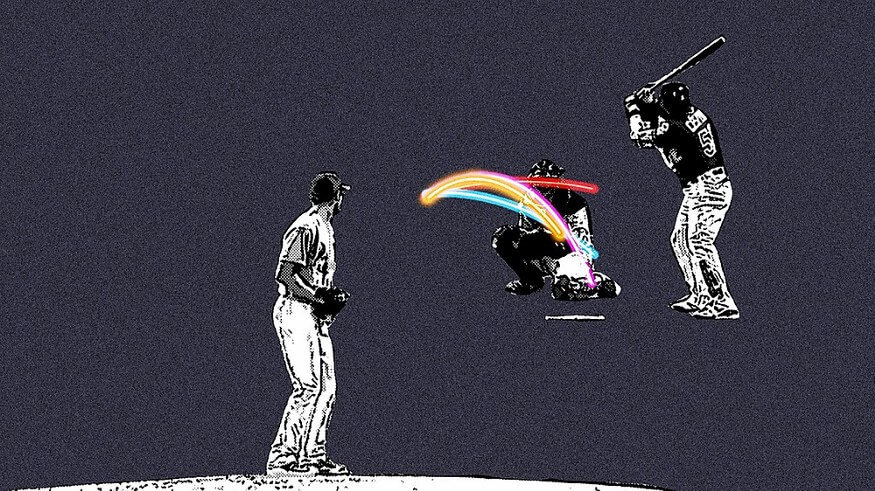
But what exactly is pitch tunneling? Simply put, it’s the process of pitchers throwing all pitches along the same trajectory for as long as possible before they reach a “tunnel point” and diverge, revealing their true, distinctive breaks to the hitter. From a pitcher’s point of view, the goal here is to starve the hitter of information. If a fastball and a curveball begin from the same release point, and behave similarly for the majority of their respective journeys towards home plate until reaching the tunnel point, the ability of a hitter to collect and evaluate visual cues about pitch identity is dramatically reduced. As a result, the hitter may have to resort to guessing the pitch type based on the count of the at-bat, or delaying their swing by thousandths of a second, both of which generally lead to poor outcomes from an offensive standpoint.
Take the overlay below as an example.
Gerrit Cole, 100mph Fastball, 91mph Slider and 85mph Knuckle Curve, Overay (synced at release) pic.twitter.com/o4udTrwZkz
— Rob Friedman (@PitchingNinja) October 28, 2019
In this at-bat during the World Series, Gerrit Cole threw a 100 mph fastball, a 91 mph slider, and an 85 mph knuckle curve to Gerardo Parra. All of those pitches, independent of each other, are already incredibly hard to hit. Add to that, Cole’s ability to release each pitch from nearly identical arm slots, and to shape them so that their trajectories overlap and pass through the same tunnel point, and the challenge of hitting a baseball becomes even more difficult.
Research from Baseball Prospectus indicates that a batter’s “point of no return” is when the ball is roughly 24 feet from home plate. For a league average fastball, that means that a hitter has roughly 175 milliseconds to decide to swing at a pitch, and then actually swing, which by itself takes ~100 milliseconds. In a very real sense, the battle between pitcher and hitter is a fight over information. And as baseball players, this logically makes sense. Hitting in little league, or in a 50 mph batting cage is significantly easier because we have more time to process the visual cues being presented to us, as well as more time to make a decision based on that information.
"Why would Puig swing at a ball that bounced?" pic.twitter.com/FEmUxhlFmD
— Rob Friedman (@PitchingNinja) April 3, 2019
There are a number of examples of major league pitchers who have mastered this concept, and more overlay visualizations can be seen on the popular baseball twitter account @pitchingninja. It’s fascinating to see pitch tunneling displayed, as it gives us a unique window into just how difficult hitting is. If you’ve ever seen a batter offer at a pitch that seems so far out of the zone that it makes you think, “Why did they swing at that?” The answer likely lies in pitch tunneling. Take this 2019 at-bat from Yasiel Puig as Exhibit A.
If you just focus on the second pitch in this sequence, you’ll probably be left wondering, “Why would Puig swing at it?” And who could blame you? Not only was the pitch headed towards the left-handed batter’s box, but it even bounced in front of the plate. To be kind, Puig did not look good. But by taking a step back, and comparing the second pitch to the prior offering, a 96 mph fastball, you can begin to understand why hitters often look so utterly fooled.
Both pitches travelled through the same tunnel, which is highlighted in the sequence above when the video pauses itself. If you keep your cursor, or your finger, over where the ball stops and wait for the pitches to repeat, you’ll notice that Freddy Peralta’s fastball passes through the same “tunnel point” that his breaking pitch does. Until they reach that single point, which is roughly 24 feet away from home plate, to the untrained eye it’s incredibly difficult to discern the difference between these two pitches. This is exactly what fooled Puig in this at-bat. He had just seen an elite fastball, and the next pitch had a similar shape and trajectory, giving Puig the impression that he needed to react to another fastball. But with Peralta’s ability to tunnel these pitches, and starve hitters of critical information, he was able to fool Puig badly.
What can hitters do to fight pitch tunneling?
Nearly every matchup heavily favors the pitcher. They have detailed analyses on hitters’ hot and cold zones. They know specific pitches that hitters struggle with. They have high speed cameras at games and bullpen sessions at every level of baseball to help them refine their pitch grips and release points. Pitch tunneling tips the scales further in the pitcher’s favor. Given this state of play, it’s crucial that hitters train in a way that increases their ability to make correct swing decisions based on as little information as possible.
This has always been a challenge for hitters. Replicating in-game conditions for velocity, break, and now tunneling, at scale has never been possible. Regardless of sophistication, no pitching machine can replicate the experience of facing live pitching, and while soft-toss batting practice from a coach can be relatively helpful, it doesn’t come close to a game situation. But a revolution in technology now makes it possible for hitters to train in life-like conditions.
Through Virtual Reality, (VR) hitters can step into an environment that replicates major league, college, high school, and down to little league pitching conditions. VR has solved the biggest obstacle in training hitters. It can replicate in-game velocity and movement at scale. With VR able to simulate these conditions, and provide digital pitchers that will never fatigue, hitters can spend hours tracking pitches from an endless supply of pitcher profiles and unique release points. And now, hitters can begin to fight back against pitch tunneling in VR.
Occlusion training
Usually, “occlusion” is used in a medical context, referring to the obstruction of blood or other fluid flow. More broadly however, it simply means that something is obstructed. Specifically for our context, occlusion refers to the obstruction of information about the true nature of a pitch type; or, what we know as pitch tunneling. WIN Reality’s Occlusion Training teaches hitters to overcome tunneling by identifying previously unnoticed but available pieces of information about the pitch. Instead of being forced to guess what the pitch is going to be, WIN Reality athletes learn how to “rely on the earliest bits of useful information indicating possible pitch type, location, and timing, to build predictive models (in their heads) and improve how they process that early information.”
In this training exercise, the hitter enters the virtual environment, in which a window (or tunnel) is placed roughly 20 feet from home plate. As the ball is thrown, the goal of the batter is to take in as much information about the identity of the pitch as possible, before it reaches the window, at which point the ball disappears completely. Hitters are then prompted to correctly identify what the pitch was. As they grow more comfortable with this training method, they can gradually move the window closer and closer to the VR pitcher, which further restricts the amount of information they’ll have to work with. With this kind of training, hitters can make enormous gains that translate to increased batting average, OPS, and ultimately their team’s ability to win games. This is how hitters train to defeat pitch tunneling in real game action.
In the war between pitchers and hitters, science and technology have favored pitchers. But now these kinds of advances are increasingly becoming available to hitters. In addition to Occlusion Training, WIN Reality also offers dedicated programs around “Zone Cataloging”, “Swing Decisions”, “Quick Recognition”, and eventually, pure practice at-bats. This type of training is new to the hitting community. It’s reasonable to wonder if what’s learned in the VR environment yields results in the real world. Will gains made in simulations be transferable to the in-game situation? The answer is a resounding yes. Facing pitch tunneling and future developments that will help pitchers, it’s vital that hitters level the playing field and use VR environments and training tools to help better their chances of success. It’s not enough to just take hundreds of swings in your local batting cage, or face your coach in soft-toss before a game. Players need to be practicing in ways that transfer directly to real world scenarios, and to do that, VR is the answer.