Every hitter wants the same thing: more hard contact and fewer weak at-bats. The problem is that most players only practice one part of hitting: the swing itself. Great hitters train four skills: timing, vision, bat-to-ball contact, and power. Miss one, and the others suffer.
This guide breaks down 13 proven baseball hitting drills organized by those four pillars. Each drill includes step-by-step instructions, common mistakes, age recommendations, and progression levels so you can build a plan that actually works, whether you are 8 or 18.
The Short Answer: Top 5 Hitting Drills Every Player Needs
If you only have 15 minutes to train, start here. These five drills cover all four hitting pillars and work for every age group.
- Soft Toss (Timing) — Develops rhythm and load timing from a controlled feed. 3 sets of 10 swings.
- Tracking Drill (Vision) — Trains pitch recognition by calling ball or strike on every pitch without swinging. 20 pitches per round.
- Tee Work With Target Zones (Contact) — Hit line drives to specific field zones off a tee. 5 swings per zone, 3 zones.
- Medicine Ball Rotational Throw (Power) — Builds core rotational force that transfers directly to bat speed. 3 sets of 8 throws.
- Front Toss With Timing Cues (Timing + Vision) — A coach gives a verbal cue (“now”) at release, forcing the hitter to recognize and react. 3 rounds of 10 pitches.
These five drills take about 15 minutes and cover timing, vision, contact, and power. For a full breakdown, keep reading.
Key Hitting Skills to Focus On
Before jumping into individual drills, understand the four pillars that make up a complete hitter.
Timing
Timing is the foundation. A hitter with a perfect swing but late timing hits nothing but weak grounders. Timing drills train the internal clock — learning when to start the load, when to commit, and how to adjust between fastballs and off-speed.
Vision
Pitch recognition separates good hitters from great ones. Research from the American Sports Medicine Institute shows that elite hitters make pitch-type decisions within 150–200 milliseconds of release. Vision drills build that processing speed.
Bat-to-Ball Contact Skills
Consistent hard contact requires barrel accuracy. Contact drills isolate hand-eye coordination and bat path so hitters can square up pitches across all zones — inside, outside, high, and low.
Power
Power comes from the ground up: legs, hips, core, then hands. Power drills build the kinetic chain that turns rotational force into exit velocity. For reference, average exit velocities by age: 12U players typically range 50–60 mph, 14U players 60–70 mph, and high school varsity hitters 75–90+ mph (source: Blast Motion data).
The Best Hitting Drills for Improving Vision
1. Tracking Drill
Best for: All ages (8U through college)
Progression:
– Beginner — machine pitching at moderate speed
– Intermediate — live pitching at game speed
– Advanced — call pitch type AND location before the ball crosses the plate
Step-by-step:
1. Stand in the batter’s box with your bat on your shoulder (no swinging).
2. Watch each pitch from release point to the catcher’s glove.
3. Call “ball” or “strike” before the pitch reaches the plate.
4. Complete 20 pitches per round, 2–3 rounds per session.
What it develops: Pitch recognition speed, discipline, and zone awareness. Forces hitters to read spin and trajectory instead of guessing.
Common mistakes:
– Looking at the pitcher’s arm instead of the release point
– Calling the pitch too late, the goal is to decide early
– Losing focus after 10–12 pitches (take a break between rounds)
2. Colored Ball Drill
Best for: Ages 10 and up
Progression:
– Beginner — 2 colors, call after catch
– Intermediate — 3 colors, call before catch
– Advanced — 4 colors + swing only at one designated color
Step-by-step:
1. Use colored training balls (or mark balls with colored tape: red, blue, green).
2. A partner soft-tosses from 10–15 feet away.
3. The hitter calls the color before the ball arrives.
4. In the advanced version, swing only at the designated color and take all others.
What it develops: Visual processing speed and selective attention. Trains the brain to pick up information faster out of the hand.
Common mistakes:
– Guessing instead of reading. If accuracy drops below 70%, slow down the toss
– Standing too far away (keep distance at 10–15 feet for youth players)
3. Release Point Focus Drill
Best for: Ages 12 and up (requires live or machine pitching)
Progression:
– Beginner — identify fastball vs. off-speed
– Intermediate — call pitch type within the first 10 feet of flight
– Advanced — identify spin direction (topspin, backspin, slider spin)
Step-by-step:
1. Set up in the box against live pitching or a pitching machine with mixed speeds.
2. Focus exclusively on the pitcher’s release point, not the windup, not the arm.
3. Call pitch type as early as possible.
4. Track 15–20 pitches per round without swinging.
What it develops: Earlier pitch recognition by training the eyes to lock onto the smallest window of information. Elite hitters read the ball within the first 6–10 feet of flight.
Common mistakes:
– Watching the full delivery instead of isolating the release window
– Getting discouraged by early misreads. Accuracy improves over 3–4 sessions
The Best Hitting Drills for Better Timing
4. Soft Toss
Best for: All ages (6U through pro)
Progression:
– Beginner — front toss from 10 feet, consistent speed
– Intermediate — angled toss from 45 degrees, varying height
– Advanced — rapid-fire toss (1-second intervals) with directional targets
Step-by-step:
1. A partner kneels at a 45-degree angle, 10–15 feet from the hitter.
2. Toss the ball underhand into the strike zone at a consistent arc.
3. The hitter loads on the toss and drives the ball into a net or open field.
4. Complete 3 sets of 10 swings.
What it develops: Load timing, rhythm, and swing consistency. The controlled feed lets hitters focus entirely on when to start and when to fire.
Common mistakes:
– Rushing the load — wait for the toss to reach the apex before committing
– Tosser feeding too fast or too slow (keep a steady 2-second rhythm)
– Hitter pulling off the ball instead of driving through contact
5. Front Toss With Timing Cues
Best for: Ages 10 and up
Progression:
– Beginner — verbal “now” cue at release
– Intermediate — silent cue (visual signal only)
– Advanced — alternating “swing” and “take” commands to train on/off decisions
Step-by-step:
1. A coach or partner stands behind an L-screen, 20–25 feet away.
2. Toss the ball overhand or with a flip from behind the screen.
3. Give a verbal timing cue (“now”) exactly at the moment of release.
4. The hitter uses the cue to start the load — then tracks and swings.
5. Complete 3 rounds of 10 pitches.
What it develops: The connection between visual pickup and swing initiation. Teaches hitters to react to a trigger rather than guess.
Common mistakes:
– Hitter pre-loading before the cue (defeats the purpose — reset every rep)
– Cue timing too early or late — the coach must be consistent
– Swinging at everything in the advanced version (the “take” reps are the real training)
6. Live Batting Practice With Pitch Count Awareness
Best for: Ages 12 and up
Progression:
– Beginner — 5-pitch at-bats, swing at anything in the zone
– Intermediate — full counts with take/swing decisions
– Advanced — simulated game at-bats (runner scenarios, 2-strike approach)
Step-by-step:
1. Set up standard BP with a live pitcher or machine.
2. Instead of “get your swings in,” simulate real at-bats: 3–5 pitch sequences per turn.
3. Hitter must take pitches out of the zone and compete within the count.
4. Track strike percentage and hard-contact rate per round.
What it develops: In-game timing under realistic conditions. Eliminates the “BP hitter” problem where players hit well in practice but struggle in games.
Common mistakes:
– Swinging at every pitch (the discipline to take is the skill being trained)
– Not tracking results — keep a simple tally of hard contact vs. weak contact
The Best Hitting Drills for Improving Contact Skills
7. Tee Work With Target Zones
Best for: All ages (6U through pro)
Progression:
– Beginner — hit line drives to center field only
– Intermediate — rotate through 3 zones (pull, center, opposite)
– Advanced — coach calls the zone after the hitter loads, forcing late adjustment
Step-by-step:
1. Set a tee at the center of the strike zone.
2. Place targets (cones, buckets, or markers) at pull-side, center, and opposite-field positions.
3. Hit 5 line drives to each zone. Adjust tee position (front, middle, back of the plate) to match the zone.
4. Track how many of 15 total swings hit the intended target area.
What it develops: Barrel control, bat path precision, and the ability to use the whole field. This is the single most effective contact drill at any level.
Common mistakes:
– Trying to muscle the ball to the opposite field instead of letting contact point dictate direction
– Setting the tee too high or too low (match it to the hitter’s actual strike zone)
– Rushing between reps — reset stance and load every time
8. Short-Bat or One-Hand Drill
Best for: Ages 10 and up
Progression:
– Beginner — top hand only, off a tee
– Intermediate — bottom hand only, off soft toss
– Advanced — alternate hands every 5 swings off front toss
Step-by-step:
1. Use a short training bat or choke up significantly on a regular bat.
2. Hit off a tee or soft toss using only the top hand (for 10 reps), then only the bottom hand (for 10 reps).
3. Finish with 10 reps using both hands, focusing on how each hand contributes.
What it develops: Hand-eye coordination, barrel awareness, and independent hand strength. The top hand controls the barrel path; the bottom hand drives through the zone.
Common mistakes:
– Gripping too tight with one hand (stay relaxed — the bat should feel light)
– Dropping the barrel on bottom-hand swings (keep the knob moving toward the ball)
9. High-Low Tee Drill
Best for: Ages 8 and up
Progression:
– Beginner — alternate between high and low tee positions (5 each)
– Intermediate — coach randomly sets height before each swing
– Advanced — add inside/outside variation for 4-zone coverage
Step-by-step:
1. Set the tee at the top of the strike zone. Hit 5 line drives.
2. Move the tee to the bottom of the strike zone. Hit 5 line drives.
3. Alternate randomly (coach calls “high” or “low” before each swing).
What it develops: Adjustability and bat path discipline across the vertical zone. Hitters learn to stay through the ball high and drive down on low pitches without dropping the barrel.
Common mistakes:
– Using the same swing for both heights (the whole point is adjusting the path)
– Popping up high pitches — focus on staying on top of the ball
– Chopping at low pitches — drive through with a slight uppercut
The Best Hitting Drills for Increasing Power
10. Medicine Ball Rotational Throw
Best for: Ages 10 and up (use age-appropriate ball weight: 4 lb for 10–12, 6 lb for 13–15, 8 lb for 16+)
Progression:
– Beginner — stationary stance, throw into wall
– Intermediate — stride and throw, partner catch
– Advanced — rapid-fire rotational throws (8 reps in 15 seconds)
Step-by-step:
1. Stand sideways to a wall or partner, feet shoulder-width apart.
2. Hold a medicine ball at the back hip in a batting-stance load position.
3. Rotate explosively from the hips, extending the arms to release the ball into the wall.
4. Reset and repeat. 3 sets of 8 throws.
What it develops: Core rotational power, the primary engine of bat speed. Rotational medicine ball throws are a staple of pro-level swing development programs. Coaches consistently see the power gains transfer directly to exit velocity.
Common mistakes:
– Throwing with the arms instead of rotating from the hips
– Using a ball that is too heavy (sacrifice speed for weight and you train the wrong movement pattern)
11. Overload/Underload Bat Training
Best for: Ages 12 and up
Progression:
– Beginner — 5 swings heavy, 5 swings light
– Intermediate — alternating heavy/light every 2 swings
– Advanced — timed rounds (max bat speed on underload swings, measured with Blast Motion or similar sensor)
Step-by-step:
1. Use a weighted bat (overload) for 5 dry swings at 80% effort, focusing on staying connected.
2. Switch to a lighter bat or training bat (underload) for 5 swings at max effort.
3. Finish with 5 swings using your game bat.
What it develops: Bat speed through contrast training. Overload builds strength through the swing path; underload trains the nervous system to move faster. Overload/underload protocols are widely shown to increase bat speed by 3–5% over a 6–8 week program.
Common mistakes:
– Swinging the heavy bat at max effort (the overload phase is about controlled strength, not speed)
– Skipping the game-bat finish (the transfer set is where the brain locks in the new speed)
12. Resistance Band Hip Rotation
Best for: Ages 12 and up
Progression:
– Beginner — slow, controlled rotation with hold at contact point
– Intermediate — explosive rotation with band, 3 sets of 10
– Advanced — add a stride into the rotation to mimic full swing mechanics
Step-by-step:
1. Anchor a resistance band to a fence or pole at hip height.
2. Stand in your batting stance with the band wrapped around your lead hip.
3. Load and rotate explosively against the band’s resistance, stopping at the contact-point position.
4. Hold for 1 second, then reset. 3 sets of 10 reps per side.
What it develops: Hip rotation speed and the separation between hips and shoulders that creates whip in the swing.
Common mistakes:
– Letting the band pull you back instead of holding the finish position
– Rotating only the upper body, the hips must lead
13. Weighted Ball Long Toss (Hitting Variation)
Best for: Ages 14 and up
Progression:
– Beginner — hit heavy training balls off a tee into a net
– Intermediate — hit heavy balls off soft toss
– Advanced — alternate heavy and standard balls every 3 swings
Step-by-step:
1. Use a weighted hitting ball (6–8 oz vs. a standard 5 oz baseball).
2. Set up on a tee or soft toss into a net.
3. Hit 10–15 reps focusing on driving through the ball with full extension.
4. Switch to a standard ball for 10 reps to feel the speed difference.
What it develops: Strength through the contact zone. The heavier ball forces the hitter to stay connected and drive through rather than flicking the bat head.
Common mistakes:
– Trying to pull heavy balls (focus on center-field line drives)
– Not switching to standard balls afterward (the contrast is where the power gain registers)
Warm-Up Routine Before Hitting Drills
Never jump straight into full swings. A 5–7 minute warm-up protects against injury and improves performance.
- Arm circles and shoulder band pulls — 30 seconds each direction. Loosens the rotator cuff and upper back.
- Hip circles and leg swings — 10 each side. Opens the hips for rotation.
- Torso rotations with a bat behind the shoulders — 15 slow, controlled rotations. Activates the core and warms the thoracic spine.
- Dry swings at 50% effort — 10 swings. Grooves the swing path before adding ball contact.
- Light tee work — 10–15 easy swings focusing on contact point, not power.
This sequence takes about 5–7 minutes and gets the body ready for high-intent drill work.
Drill Progression Chart
Use this chart to match drills to skill level and build a training path from beginner to advanced.
| Drill | Beginner | Intermediate | Advanced | Ages |
|---|---|---|---|---|
| Tracking Drill | Machine pitch, moderate speed | Live pitch, game speed | Call pitch type + location | 8+ |
| Colored Ball Drill | 2 colors, call after catch | 3 colors, call before catch | 4 colors + selective swing | 10+ |
| Release Point Focus | ID fastball vs. off-speed | Call type in first 10 ft | ID spin direction | 12+ |
| Soft Toss | Front toss, consistent speed | Angled toss, varied height | Rapid-fire + directional | 6+ |
| Front Toss With Cues | Verbal cue at release | Visual signal only | Swing/take commands | 10+ |
| Live BP With Counts | 5-pitch at-bats | Full counts, take/swing | Simulated game scenarios | 12+ |
| Tee Work With Zones | Center field only | 3 zones, rotate | Coach calls zone post-load | 6+ |
| Short-Bat / One-Hand | Top hand, off tee | Bottom hand, soft toss | Alternate hands, front toss | 10+ |
| High-Low Tee | Alternate high/low | Random coach calls | 4-zone coverage | 8+ |
| Med Ball Rotation | Stationary, wall throw | Stride + partner catch | Rapid-fire, 8 in 15 sec | 10+ |
| Overload/Underload | 5 heavy, 5 light | Alternate every 2 swings | Timed max-speed rounds | 12+ |
| Resistance Band Hips | Slow rotation + hold | Explosive, 3×10 | Add stride | 12+ |
| Weighted Ball Hitting | Heavy balls off tee | Heavy balls off soft toss | Alternate heavy/standard | 14+ |
VR Hitting Drills With TrainVR
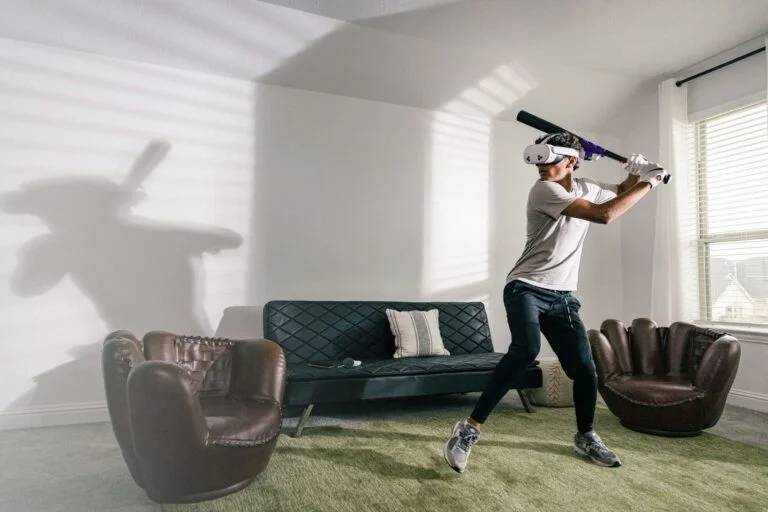
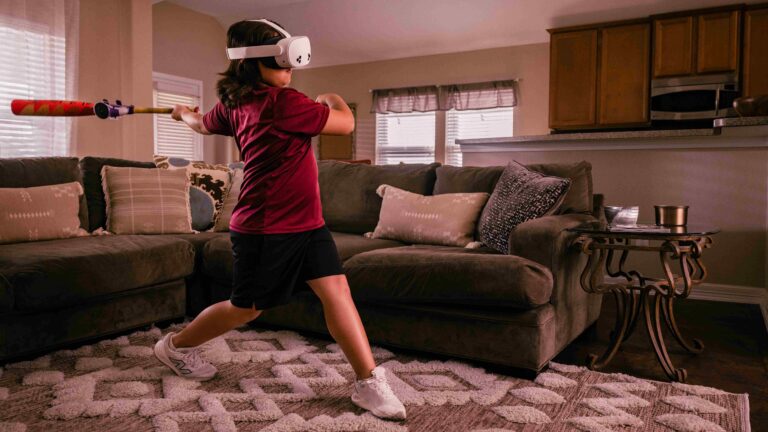
Traditional drills build the foundation. TrainVR takes those same skills — timing, vision, pitch recognition, and decision-making — and trains them at game speed in virtual reality using a Meta Quest headset.
TrainVR gives hitters access to 600+ real pitcher deliveries, every pitch type, and structured training tracks designed by professional hitting coaches. No field, cage, or live pitcher needed.
Key TrainVR Training Tracks for Hitters
- Pitch Recognition Track — Trains the ability to identify pitch type and location within the first 10 feet of ball flight. Mirrors the Tracking Drill and Release Point Focus Drill above, but at true game speed with realistic spin and movement.
- Timing and Rhythm Track — Builds internal clock through sequenced at-bats against varying pitch speeds. Develops the same skills as Soft Toss and Front Toss drills, with the added challenge of real velocity and off-speed tunneling.
- Disappearing Pitch Drill — The ball disappears partway to the plate, forcing hitters to read trajectory early and commit. This is the VR equivalent of the Colored Ball Drill — it trains early visual processing and decision speed.
- Batting Practice Mode — Full at-bats against game-speed pitching with swing tracking. The VR version of Live BP With Counts — compete in realistic scenarios with pitch-count awareness.
- Exhibition Mode — Face specific game situations (0–2 counts, runners in scoring position, lefty/righty matchups) to build situational timing and approach.
Why VR Drills Complement Traditional Training
Traditional cage work gives hitters about 20–30 quality swings per session. TrainVR lets players see 100+ pitches in the same timeframe — with pitch types, speeds, and scenarios they may never see in local batting practice. Players who combine VR reps with physical drill work develop faster pitch recognition and better in-game timing because they have already seen those pitches thousands of times.
Coach’s Hitting Practice Plan
Use these templates to structure team hitting practice around the four pillars. Each plan fits a 45–60 minute practice block.
30-Minute Quick Session (Individual or Small Group)
| Block | Time | Drill | Focus |
|---|---|---|---|
| Warm-up | 5 min | Arm circles, hip circles, dry swings, light tee | Prep |
| Vision | 5 min | Tracking Drill — 20 pitches | Pitch recognition |
| Timing | 8 min | Soft Toss — 3×10 swings | Load timing |
| Contact | 7 min | Tee Work With Zones — 3 zones, 5 swings each | Barrel accuracy |
| Power | 5 min | Med Ball Rotational Throws — 2×8 | Core rotation |
60-Minute Full Team Practice (Station Rotation)
Set up 4 stations. Groups of 3–4 players rotate every 12 minutes.
| Station | Drill | Equipment | Focus |
|---|---|---|---|
| Station 1 | Tee Work With Zones + High-Low Tee | Tee, balls, targets | Contact |
| Station 2 | Front Toss With Timing Cues | L-screen, balls | Timing + Vision |
| Station 3 | Overload/Underload Swings + Med Ball Throws | Weighted bats, med ball | Power |
| Station 4 | Colored Ball Drill + Short-Bat Drill | Colored balls, training bat | Vision + Contact |
Start with a 5-minute team warm-up. Finish with 5 minutes of live BP or simulated game at-bats.
Weekly Progression Plan (4 Weeks)
| Week | Focus Area | Priority Drills | Volume |
|---|---|---|---|
| Week 1 | Foundation — Contact and Vision | Tee Work, Tracking, Colored Ball | 3 sessions, 25 min each |
| Week 2 | Add Timing | Soft Toss, Front Toss With Cues, Live BP | 3 sessions, 30 min each |
| Week 3 | Build Power | Med Ball, Overload/Underload, Resistance Band | 4 sessions, 35 min each |
| Week 4 | Integrate All Pillars | Full station rotation + simulated at-bats | 4 sessions, 45 min each |
After Week 4, repeat the cycle with intermediate or advanced progressions for each drill.
How WIN Reality Can Help
WIN Reality adds the game-speed reps and personalized analysis that take drill work from the garage to the next level.
TrainVR puts game-speed pitch recognition, timing drills, and full at-bats on a Meta Quest headset. Players see 100+ realistic pitches per session — fastballs, curveballs, sliders, changeups — from the living room. Multi-week training tracks build vision, timing, and decision-making with structured progressions designed by professional coaches.
SwingAI turns your phone into a swing coach. Upload a swing video and get instant AI analysis: what is working, what needs to change, and a personalized plan to improve. Track progress over time and understand the mechanics behind hot streaks and slumps.
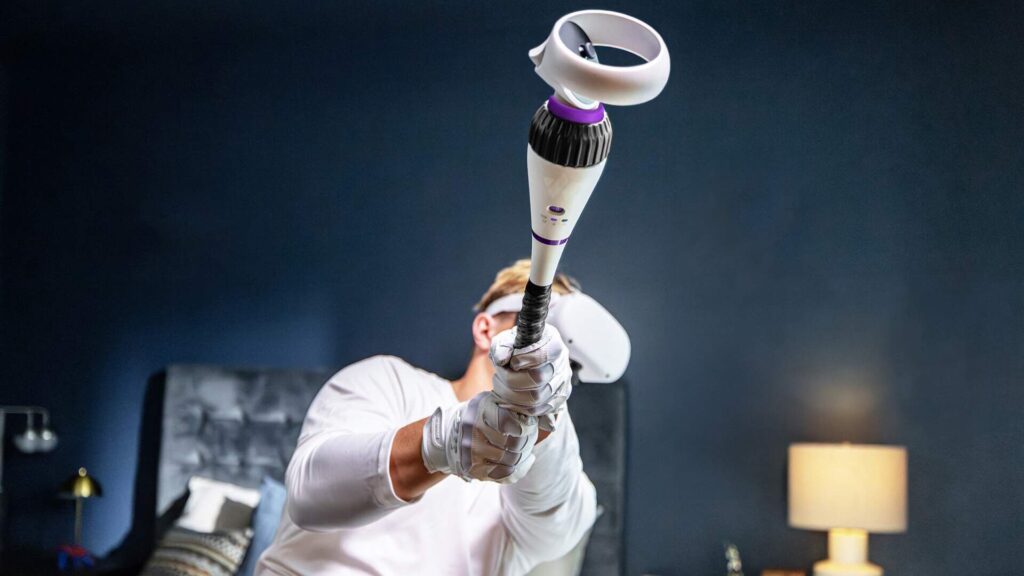
The Ultimate Hitter Pack combines TrainVR + SwingAI + a bat attachment + a Meta Quest headset into one complete hitter development system — at 50% off the first-year subscription when purchased with hardware.
Players get more game-speed reps, faster pitch reads, and better swing mechanics — no cage required.