You’ve heard the question in every dugout and batting cage: Is this VR stuff actually going to help my hitter, or is it an expensive gimmick? That question deserves a straight answer backed by real data.
The short answer is yes, VR baseball training works. But what it works for matters. The evidence is strong for visual decision skills: pitch recognition, timing, strike-zone discipline, and swing decisions. It is not a replacement for tee work, live BP, or mechanics coaching. Use it for the right skills and you’ll see measurable gains. Misuse it as a contact simulator and you’ll walk away confused by the results.
Here’s what the data actually says.
The Short Answer: Yes, VR Baseball Training Works Best for Visual Decision Skills
VR baseball training produces real, measurable improvements in pitch recognition, timing, and swing-decision accuracy. It does not replace swing mechanics coaching, live at-bats, or cage work.
Where VR training wins:
- Reading pitch shape, velocity, and spin at game speed
- Making swing/take decisions faster and more accurately
- Training strike-zone discipline (zone swing/out-of-zone swing ratio)
- Seeing more pitches — and seeing them more often — without a mound or a pitcher
Where the evidence is thinner:
- Direct improvement in swing mechanics or bat path
- Translating VR contact results to real batted-ball performance
- Replacing the feel and adjustability of live at-bats
Keep those lines clear and VR becomes one of the highest-leverage tools in your development toolkit.
What the Evidence Says About VR Baseball Training
A. WIN Reality Platform Data: TTOP, Z/O Ratio, and Performance Gains
The most compelling proof that VR hitting training transfers to real performance isn’t a controlled lab study, it’s what happens when thousands of players train consistently on WIN Reality’s TrainVR platform and their performance data gets tracked over time.
Start with TTOP: Times Through the Order Penalty.
TTOP is a known baseball phenomenon: each time a pitcher moves through the batting order, hitters perform better as every pitch becomes a new data point. WIN Reality has replicated that real-time information transfer through VR, as detailed in their VR training effectiveness research. Players who face a pitcher in TrainVR before stepping into the box show the same performance gains you’d expect from a second or third at-bat against that pitcher in a real game — without a single live pitch thrown.
Beyond TTOP, the platform data tells a consistent story:
- Players who train with WIN Reality’s VR programs see long-term gains in pitch recognition, batting averages, OPS, and team wins.
- Using WIN for just 15 minutes a day helps players develop skills like plate discipline 7x faster than those who don’t.
- Coaches at all levels report that players using WIN Reality progress faster and increase their batting average faster than those who don’t.
The Z/O ratio is another platform metric worth monitoring. Derived from Z-Swing and O-Swing rates, the Z/O ratio measures how often a hitter swings at pitches inside the strike zone relative to pitches outside the zone, adjusted for the number of pitches seen in each location. Put simply, hitters who consistently swing at strikes and lay off balls tend to have more success at the plate. That’s why regular use of TrainVR’s discipline modes is so valuable: players who train consistently improve their Z/O ratios through hundreds of game-speed decision-making reps. Over time, those gains in swing-decision accuracy translate directly into improvements in batting average and OPS.
In just 15 minutes, a batter can see over 100 game-speed pitches. In just over 6 hours of practice, a hitter can see as many pitches as a major league hitter sees in an entire season. That volume of visual decision-making reps, compounded over weeks and months, is what moves the numbers.
B. Independent Research: What Controlled Studies Have Found
The most cited controlled study on VR baseball training is Rob Gray’s 2017 Frontiers in Psychology paper. The study assigned 80 male high school baseball players equally to groups undertaking adaptive hitting training in a virtual environment (VE), extra VE batting practice, extra real batting practice, and a control condition.
The key finding: the adaptive VE group — whose training adjusted pitch speed, location, and spin rate based on performance — outperformed all other groups.
As Gray’s published findings state, players in this group had superior batting statistics in league play and reached higher levels of competition. Gray also published results from a 10-year study using a VR training protocol that produced clear evidence of transfer to real performance.
One important caveat: Gray’s VE used a projected-screen simulator, not a modern head-mounted system like Meta Quest. The fidelity was lower than what TrainVR delivers today — meaning modern VR can likely produce equal or greater transfer. But the design of the training (adaptive, varied, decision-focused) matters as much as the hardware.
A 2025 preregistered study using WIN Reality directly tested pitch recognition in 38 male players ages 11–15 over four weeks. Both the VR group and the regular-practice group improved on a video pitch-recognition test. The study noted that the four-week window may have been too short to detect live at-bat swing-decision changes and called for follow-up research using longer training schedules. The signal is clear: VR training dose matters. Consistent daily or near-daily use, compounded over a full offseason, is where the gains stack.
C. What VR Training Is Strongest For and What It Does Not Prove Yet
Here’s the evidence breakdown by skill:
Strong evidence:
- Pitch recognition — identifying pitch type, shape, and velocity window at game speed
- Timing — developing readiness and early pitch-read cues against a specific pitcher’s release point
- Swing decisions — swing/take accuracy, zone recognition, chase-rate reduction, two-strike approach
Moderate evidence:
- Mental preparation — reducing first-at-bat uncertainty, building approach confidence
- Offseason maintenance — preserving timing and recognition skills when live pitching is unavailable
Weak or unproven:
- Swing mechanics — VR is an eye trainer, not a swing trainer; if your Load Phase is broken or you’re casting, VR reps won’t fix it
- Contact metrics as performance proxies — VR exit velo and home run distance are directional feedback, not real batted-ball outcomes
- Direct stat transfer in short windows — consistent multi-week training paired with on-field work produces lasting gains; four isolated weeks won’t move your batting average
Use VR to train your eyes and your decisions, use tee work and live BP to train your hands and your swing.
Ready to see more pitches, make better decisions, and train at game speed from home?
How to Use VR Baseball Training Effectively
Method 1: Pitch Recognition and Pitch-Type Tracking
Your hitter can’t hit what they can’t read. Pitch recognition training in TrainVR teaches your eyes to pick up spin, shape, and velocity early at the release point, not when the pitch is halfway to the plate.
- Choose one pitcher and one pitch type per session. Depth of exposure beats variety in the early stages of recognition training.
- Use Release Point mode to focus visual attention on where the ball leaves the hand.
- Use Disappearing Pitch and Recognition Window drills to test whether you’ve actually internalized the read.
- Grade the results honestly. Calling pitch type correctly 70%+ of the time before the halfway point means your recognition is improving. Under 50%? You’re still guessing.
WIN Reality’s 600+ virtual pitchers span 40–100+ mph, every pitch type, and every arm angle — built on actual pitch data and pitcher windups for a realistic hitting experience.
Method 2: Strike-Zone Discipline and Z/O Ratio Training
If your hitter chases breaking balls in the dirt, that’s not an aggression problem — it’s a recognition and decision problem. TrainVR’s discipline-focused modes are built to attack it.
- Set up dedicated take-pitch sessions. Run 20–30 pitches swinging only at pitches in the defined strike zone. No reward for contact — only correct swing/take decisions.
- Use 0-2 and 3-2 count scenario workouts to force pressure-count decision-making. League average drops to .165 with two strikes — this is where games are won and lost.
- Track your Z/O ratio across three to four sessions. If it’s moving up, your eyes are improving. If it’s flat, you’re gaming the system.
Using WIN for just 15 minutes a day helps players develop skills like plate discipline 7x faster than those who don’t. The goal of every discipline session: make better decisions on pitch two than you did on pitch one.
Method 3: Game-Like Timing Reps Without Overvaluing Contact Metrics
Here’s the trap most hitters fall into with VR: treating the virtual home run distance or exit velocity as a real performance grade. It’s not.
VR contact feedback is a directional cue, not a diagnostic. Consistently making contact early in the rotation? You’re likely early on timing. Under pitches? Your load is late. Useful signals — but the virtual scoreboard means nothing if your swing path has a Barrel Dump flaw.
Use TrainVR timing reps the right way:
- Run 3–4 at-bats in Exhibition Mode before live tee work or cage sessions. This primes your timing system and makes subsequent physical reps more productive.
- Use multi-week Training Tracks to structure progression. Adaptation requires progressive overload, even in VR.
- Pair VR sessions with tee or front-toss work the same day. 15 minutes of TrainVR timing reps followed by 20 minutes on the tee reinforces the visual pattern with physical repetition — eyes first, hands second.
How WIN Reality Helps
You want your hitter seeing pitches faster, making better decisions, and stepping into live at-bats with confidence. That’s exactly what TrainVR is built to deliver.
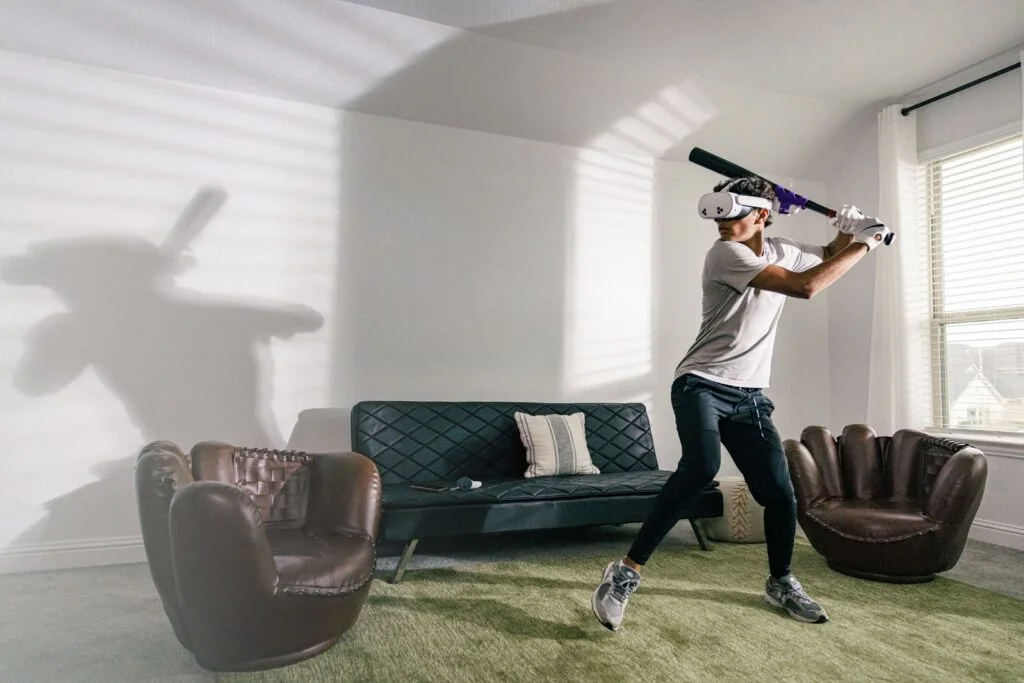
TrainVR is WIN Reality’s virtual reality system that delivers thousands of game-speed pitch reps, helping you sharpen decision-making, pitch recognition, and timing against real pitchers.
Here’s what the platform gives you:
- 600+ virtual pitchers spanning 40–100+ mph, every arm angle, every pitch type
- Structured training modes: Pitch Recognition, Release Point, Disappearing Pitch, Batting Practice, and Exhibition Mode
- Scenario-based workouts: breaking ball recognition, 3-2 counts, two-strike approach, and more
- Performance dashboards: TTOP tracking, Z/O ratio, and session-over-session progress metrics
- Multi-week Training Tracks that build systematically toward a performance target
Pair TrainVR’s pitch-speed reps with SwingAI’s AI biomechanics analysis and you’ve got the full development loop covered — eyes, decisions, and swing mechanics tracked together. The Ultimate Hitter Pack bundles TrainVR + SwingAI annual subscription + WIN bat attachment in one package.
Since 2020, players have trained daily with WIN Reality’s TrainVR platform, using virtual reality to gain live at-bats from home, sharpen pitch recognition, and simulate high-pressure game situations — all before stepping into an actual batter’s box.
The evidence is clear. The platform is proven. The only question is how many pitches your hitter is going to see before their next at-bat.
See more pitches. Make smarter decisions. Train at home with WIN Reality.