Exit velocity is the single most telling number in a hitter’s toolbox. It measures how hard the ball leaves the bat. At every level, the data is clear: hitters who consistently barrel the ball at higher speeds get more hits, more extra-base hits, and more looks from the next level.
Whether you are an 11-year-old trying to break 60 mph or a high school junior chasing 90, knowing where you stand against your age group is the first step toward getting better. This guide breaks down exit velocity benchmarks by age for both baseball and softball, explains how to measure it, and gives you the drills and tools to raise it.
The Short Answer: Exit Velocity by Age
Here are the typical maximum exit velocity ranges we see at each level of baseball. These represent a player’s ceiling (the hardest ball they are capable of hitting) not their average across all batted balls.
| Age | Average Player Max | Elite Player Max |
|---|---|---|
| 8–10u | 45–55 mph | 55–65 mph |
| 11–12u | 55–60 mph | 60–70 mph |
| 13–14u | 60–65 mph | 65–75 mph |
| JV / 15u | 70–80 mph | 75–85 mph |
| Varsity / 16–18u | 85–90 mph | 90–100 mph |
| College | 95–100 mph | 100–110 mph |
| Pro | 105–110 mph | 115–120 mph |
For context: MLB Statcast data shows that when a ball is hit at 96 mph or higher, batting average jumps above .300. Drop just 1 mph to 95, and it falls to .265. At 104 mph, 30% of batted balls go for extra bases. At 119 mph, that number reaches 72% (source: Baseball Savant).
The lesson applies at every level. Hit it harder, and good things happen.
Breaking Down Exit Velo by Age
Youth Baseball (8–12u)
Most 8-10u players max out between 45 and 55 mph. By 12u, average players reach the high 50s, and elite travel ball hitters begin touching the mid-to-upper 60s.
At this stage, exit velocity gains come almost entirely from improving mechanics and bat-to-ball skills, not from strength training. Players who learn to square the ball consistently will see their average exit velo climb even before their max does.
Benchmark goal: Reach a max exit velocity in the 60s by the time you leave 12u.
Middle School (13–14u)
This is where the gap between average and elite starts to widen. Average players top out in the low-to-mid 60s. Elite 14-year-olds regularly hit in the low-to-mid 70s.
Physical maturation plays a role, but efficient swing mechanics remain the primary driver. Players who start training explosive movements (jumps, med ball throws, sprints) alongside their hitting work will see faster progress.
Benchmark goal: Reach a max exit velocity in the 70s by the end of 14u.
High School (15–18u)
High school is where exit velocity becomes a differentiator for recruiting. JV players typically max out between 70 and 80 mph. Varsity hitters sit in the 85–90 range, and elite prospects push into the 90s.
At this stage, strength training with heavy weights, bat speed training, and regular swing analysis all become critical. Hitters who consistently hit 90+ mph start showing up on college recruiting radars.
Benchmark goal: Reach the 80s on JV. Hit 90+ by your junior year if you are targeting college ball.
College and Pro
Most college hitters max out in the mid-to-upper 90s. Elite college and minor league players consistently reach the 100s. At the MLB level, the average exit velocity on hard-hit balls sat at 92.4 mph during the 2025 season, with the league-wide average max exit velocity above 110 mph (source: MLB Statcast via Baseball Savant).
Benchmark goal: 95+ mph to compete at the college level. 105+ mph to profile as an MLB hitter.
Softball Exit Velo Benchmarks
Exit velocity matters just as much in softball, but the numbers look different because of lighter bats, shorter distances, and different swing mechanics. Here are the typical max exit velocity ranges for fastpitch softball:
| Age | Average Player Max | Elite Player Max |
|---|---|---|
| 10u | 35–45 mph | 45–50 mph |
| 12u | 40–50 mph | 50–58 mph |
| 14u | 50–58 mph | 58–65 mph |
| 16u / JV | 55–63 mph | 63–70 mph |
| 18u / Varsity | 60–68 mph | 68–75 mph |
| College | 65–73 mph | 73–80+ mph |
Key difference: Softball fields are smaller, so even a lower absolute exit velocity carries more impact. A 65 mph exit velo in fastpitch softball, with a 43-foot pitching distance and 60-foot baselines, gives infielders roughly the same reaction time as an 85 mph exit velo in baseball.
Benchmark goals for softball:
– 12u: Aim for 50+ mph max
– 14u: Target the upper 50s to low 60s
– High school: 65+ mph puts you in the conversation for college programs
– College: Elite D1 softball hitters consistently hit 73+ mph
The same two-skill improvement framework applies: get better at squaring the ball up, and increase bat speed. The drills in this guide work for both baseball and softball players.
Exit Velocity Benchmarks You Should Shoot For
Setting specific exit velocity goals gives your training direction. Here is a goal-setting framework by age group:
- Youth (8–12u): Reach a max exit velocity in the 60s by 12u. Focus entirely on bat-to-ball skills and mechanics. Do not chase max bat speed at this age.
- Middle School (13–14u): Target a max in the 70s. Begin adding explosive movement training alongside swing work.
- High School (15–18u): Aim for the 80s, with elite players targeting 90+. Strength training, bat speed training, and regular swing analysis are now essential.
- College and Pro: Most college hitters need 95+ mph to compete. Pro hitters consistently hit 105+.
The biggest gains in exit velocity typically happen during middle school and high school, when players experience rapid physical growth. But development varies. Periodic testing, rather than daily obsession, gives you the clearest picture of progress.
How to Measure Exit Velocity
You can’t improve what you don’t measure. Here are the most common tools for tracking exit velo:
Rapsodo
Rapsodo hitting units use radar and camera technology to capture exit velocity, launch angle, and batted ball direction in real time. They are popular with college programs and high-level travel ball organizations. Rapsodo provides detailed data on every swing, making it a strong choice for players who want granular feedback.
Best for: High school, college, and travel ball players with access to a cage or facility.
Blast Motion
Blast Motion bat sensors attach to the knob of any bat and measure bat speed, hand speed, time to contact, and more. While Blast does not directly measure exit velocity off the ball, its bat speed data is a reliable predictor — and many coaches use Blast metrics as proxy benchmarks.
Best for: Players at any age who want swing data from every practice rep without a radar setup.
HitTrax
HitTrax is a full batting cage simulator that tracks exit velocity, launch angle, distance, and spray direction. It gamifies the experience by projecting batted ball outcomes onto real stadium dimensions. Many indoor training facilities and travel ball organizations use HitTrax for evaluations and player development.
Best for: Players who train at indoor facilities and want game-like feedback from cage work.
WIN Reality
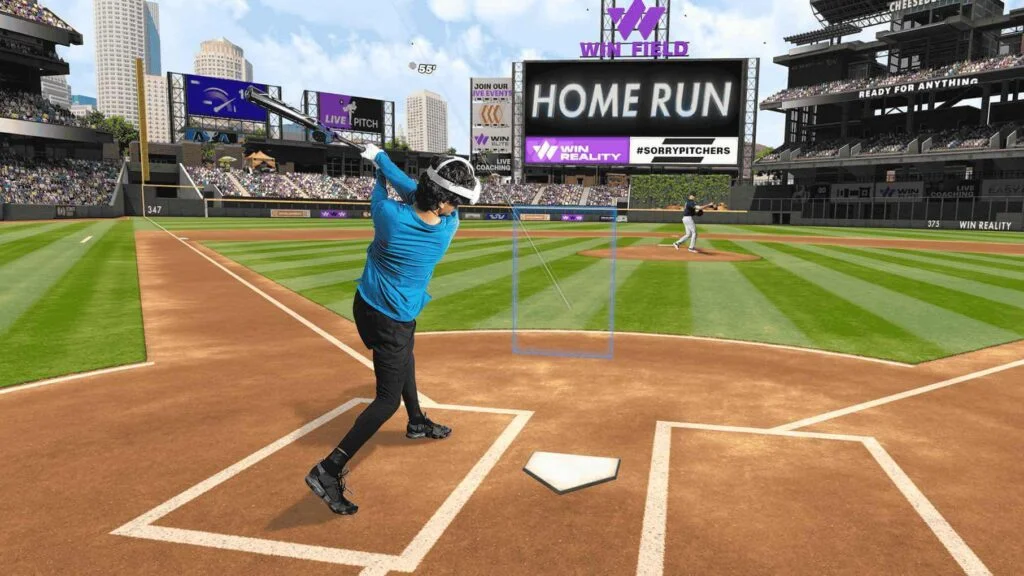
WIN Reality’s platform tracks swing data through two tools. SwingAI analyzes your swing from phone video, providing biomechanics-style feedback on mechanics that directly affect how well you barrel the ball. TrainVR puts you in the batter’s box against game-speed pitching on a Meta Quest headset, training pitch recognition and timing — the cognitive skills that determine whether you square the ball up in the first place.
Best for: Players at any age who want to train bat-to-ball skills and swing mechanics from home.
How to Improve Your Exit Velo
There are two paths to higher exit velocity. You need both.
Skill #1: Better Bat-to-Ball Skills = Higher Average Exit Velo
Squaring the ball up more often will not raise your absolute max. But it will raise your average exit velocity across all batted balls — and that is what shows up in game production.
The data is straightforward: most balls in play are not fully squared. Mishits, foul tips, and weak contact drag your average down. If you can move your barrel to the ball more consistently, your average exit velo climbs without adding a single mile per hour to your ceiling.
Drills to improve bat-to-ball skills:
- Hitting With a Skinny Bat — Forces precision. A narrower barrel leaves less margin for error, training you to find the center of the ball. Works for all ages.
- Stop at Contact Drill — Teaches hitters to stay inside the ball, match the pitch plane, and keep hands connected through contact. Great for youth through high school players who tend to roll over or hook the ball.
- Power V Drill — Reinforces staying behind, inside, and through the ball. Ideal for 12u and up, especially hitters who cast their hands or lose bat path early.
Skill #2: Increased Bat Speed = Higher Max Exit Velo
Bat speed is the other half of the equation. Faster bat, harder contact, assuming you square it up. But bat speed training should be age-appropriate:
- Ages 8–14: Focus on swinging with intent and moving efficiently. The biggest gains at this age come from better mechanics, not strength. Regularly evaluate your swing through video analysis or biomechanics reports to make sure you are building good movement patterns. Add explosive movements (jumps, med ball throws, sprints) starting around 13–14.
- Ages 15+: Hit the weight room. Prioritize strength training with a focus on speed and power. This is the stage to begin dedicated bat speed training with overload/underload protocols and high-intent swing work.
Drills to improve bat speed:
- Shuffle Ups — Teaches hitters to generate momentum, move fast, and build bat speed through the lower half. Best for ages 13 and up.
- Recoil Swings — Forces a tight turn, center-body rotation, and rapid acceleration and deceleration. Builds the fast-twitch movement patterns that produce hard contact. Works for ages 12 and up.
- Knob to Knee Drill (High Intent) — Emphasizes loading, creating separation, and gaining momentum into the swing. Reinforces swinging with damage intent. Best for high school and older players.
- Med Ball Shot Put and Scoop Toss — Teaches explosive loading and unloading of the body in the proper sequence. Builds rotational power that transfers directly to the swing. Works for ages 13 and up.
Whether you prioritize bat-to-ball skills or bat speed, the combination of both is what drives exit velocity up over time.
How WIN Reality Can Help
Improving exit velocity takes two things: better contact quality and faster bat speed. WIN Reality’s platform trains both.
TrainVR puts you in the batter’s box against game-speed pitching on a Meta Quest headset — no field, cage, or live pitcher required. TrainVR’s drills train the cognitive skills behind squaring the ball up: pitch recognition, timing, pitch-plane tracking, and swing decisions. Players who improve these skills square up more pitches, which drives average exit velocity higher in games. TrainVR includes hundreds of curated workouts, structured multi-week Training Tracks, and scenario-based drills that simulate real at-bat situations.
SwingAI turns your smartphone into a professional swing coach. Upload any swing video and get instant AI-powered analysis: what is working, what needs to change, and a personalized plan to improve. SwingAI delivers biomechanics-style feedback on the specific mechanics that affect how efficiently you transfer bat speed into ball speed. Track your progress over time, catch swing flaws before they become slumps, and know exactly what to work on in your next session.
Together, TrainVR and SwingAI cover both sides of the exit velocity equation. Train your eyes and timing with VR reps, then refine your mechanics with AI swing analysis. No cage required.
FAQ
What Is a Good Exit Velocity for a 12-Year-Old?
A good max exit velocity for a 12-year-old baseball player is in the upper 50s to low 60s. Elite 12u players regularly reach 65–70 mph. If you are consistently hitting in the upper 50s, you are tracking well. Focus on bat-to-ball skills and efficient mechanics at this age — max bat speed training can wait.
What Is a Good Exit Velocity for a 14-Year-Old?
For a 14-year-old, a strong max exit velocity is in the mid-to-upper 60s. Elite 14u players hit in the low-to-mid 70s. This is the age where the gap between average and elite starts to widen, so consistent training matters more than ever.
What Is a Good Exit Velocity for High School Baseball?
JV players typically max out between 70 and 80 mph. Varsity hitters sit in the 85–90 mph range. If you are targeting college baseball, aim to reach 90+ mph by your junior year. College scouts use exit velocity as a key evaluation metric, so tracking and improving it should be part of your training plan.
How Do I Increase My Exit Velocity?
Two paths: improve bat-to-ball skills (to raise your average exit velo) and increase bat speed (to raise your max). For youth players, focus on mechanics and contact quality. For high school players and older, add strength training, bat speed protocols, and regular swing analysis. See the drills section above for specific exercises.
Does Exit Velocity Matter in Softball?
Yes. Exit velocity in fastpitch softball directly correlates with hitting performance, just like in baseball. The absolute numbers are lower, for example elite college softball hitters max out around 73–80 mph, but the impact is just as significant because of shorter field dimensions. A 65 mph exit velo in softball gives infielders roughly the same reaction time as an 85 mph exit velo in baseball.