Whether it is bad weather, limited cage access, or a gap before the next practice, the right indoor routine keeps development moving year-round. The best hitters, pitchers, and defenders in the country train indoors every week. The right drills in a garage, basement, or living room can be just as productive as a full-field session.
This guide covers 18 indoor baseball drills across hitting, fielding, pitching, and athletic development, plus a ready-to-use 30-minute daily routine you can start today.
The Short Answer:
Here are 18 indoor baseball drills organized by skill:
Hitting (8 drills)
– Tee Work (front, inside, outside)
– Soft Toss / Front Toss
– PVC Pipe Drill
– Wall Drill
– Slapshot Drill
– Mirror Swings
– One-Hand Swings
– Overload/Underload Bat Swings
Fielding (3 drills)
– Wall Ball
– Bare-Hand Reads
– Catcher Blocking and Framing
Pitching (3 drills)
– Towel Drill
– Rocker Throws
– Wrist Snap Drill
Athletic Development (4 drills)
– Agility Ladder
– Bodyweight Strength Circuit
– Jumping and Plyometrics
– Band Work
Keep reading for step-by-step breakdowns, age-specific recommendations, and a structured daily routine.
What You Need: Indoor Training Equipment Checklist
You do not need a full gym to train at home. Here is a practical equipment list sorted by priority:
Essentials (under $50)
– Batting tee (adjustable height)
– Wiffle balls or limited-flight training balls
– Tennis balls or foam balls
– A net or heavy blanket hung as a backstop
Recommended Additions ($50 – $150)
– Resistance bands (light and medium)
– Agility ladder
– PVC pipe or broomstick
– Plyo balls (2 oz, 4 oz) for arm care
– Weighted bat or bat sleeve
Advanced Setup
– Soft-toss machine or pop-up net with strike zone
– Overload/underload bat set
– Meta Quest headset + TrainVR subscription for game-speed pitch recognition
Most drills below need only a bat, a ball, and 10 feet of open space.
Indoor Hitting Drills
Hitting is the hardest skill in sports and the one that benefits most from daily reps. These 8 drills cover mechanics, bat path, timing, and power. You do not need a cage for any of them.
1. Tee Work (Front, Inside, Outside)
What it develops: Bat path, contact point awareness, consistency
Set up a batting tee in front of a net, heavy blanket, or garage door pad. Use wiffle balls or limited-flight balls to stay safe indoors.
- Front tee: Standard position, middle of the zone. Focus on driving through the ball with a level-to-slightly-uphill path.
- Inside tee: Move the tee forward in your stance and toward your front hip. Focus on getting the barrel out early and pulling with authority.
- Outside tee: Move the tee deeper in the zone and toward the outer edge. Stay through the ball and drive it the opposite way.
Hit 15-20 balls at each location per session. This is the single most important indoor drill. If you only have 10 minutes, spend them here.
Age guidance: Players 8 and under should start with a lighter bat and a fixed front-tee position. Add inside/outside locations at age 10+.
2. Soft Toss and Front Toss
What it develops: Timing, rhythm, hand-eye coordination
Have a partner kneel to your front-side at roughly a 45-degree angle and toss balls into the strike zone. Use wiffle balls or soft training balls indoors. Hit into a net or hanging blanket.
- Soft toss: Partner underhand-flips from the side. Focus on seeing the ball early and making clean contact.
- Front toss: Partner sits or kneels 15-20 feet in front (behind an L-screen or net) and flips overhand. This better simulates a real pitch trajectory.
Aim for 25-30 swings per round. Keep tosses consistent. The hitter should not have to chase bad feeds.
Age guidance: Soft toss from the side is ideal for ages 7-10. Transition to front toss at age 11+ as hand-eye coordination improves.
3. PVC Pipe Drill
What it develops: Hip-shoulder separation, proper loading, posture
Place a PVC pipe, broomstick, or long dowel across your upper back and behind your elbows. Take your stance and work through your load and stride sequence in slow motion.
This drill teaches hitters to lead with the hips and create stretch between the upper and lower body. You should feel your scap pinch and your posture stay tall through the rotation. If the pipe tips forward or you lose your balance, you are drifting instead of coiling.
Works for all ages. Emphasize slow, controlled reps: 10-15 per set.
4. Wall Drill
What it develops: Proper load mechanics, back-hip coil
Stand in your batting stance with your back hip 2-3 inches from a wall. Load into your back side without letting your hip or head touch the wall. If you sway, you will feel immediate feedback.
This constraint drill teaches hitters to coil into the back hip and create a true pelvis load instead of drifting backward. Focus on a controlled negative move, shift weight without lateral slide.
Works for all ages, but especially helpful for ages 10+ who are developing lower-half mechanics.
5. Slapshot Drill
What it develops: Staying through the ball, avoiding rollover
Using a bat (or a hockey stick if you have one), take a hockey-style slapshot motion focusing on driving through the contact zone with your hands working forward and your back side pushing toward the pitcher.
Hitters who tend to come around the ball and roll over will learn to maintain posture, create tilt, and stay on plane through the ball. The slapshot feel forces direction toward the pitcher instead of pulling off.
Best for ages 11+ who understand basic swing mechanics.
6. Mirror Swings
What it develops: Self-awareness, feel vs. real connection
Stand in front of a full-length mirror and take swings at both slow motion and full speed. Watch your load, stride, hand path, and finish. Compare what you feel with what you actually see.
Hitters constantly battle “feel vs. real,” what you think you are doing can be very different from what is actually happening. Mirror work bridges that gap. Record yourself on your phone for even more detailed review, or upload swings to SwingAI for instant AI-powered analysis.
Works for all ages. Younger players should have a coach or parent watch alongside them.
7. One-Hand Swings
What it develops: Hand strength, barrel control, independent hand action
Using a lightweight bat or a short training bat, take swings with your top hand only and then your bottom hand only. Hit wiffle balls off a tee into a net.
- Top hand: Builds extension and staying through the zone.
- Bottom hand: Builds connection and lead-arm direction.
Do 10-15 swings per hand. Keep the bat head above your hands and focus on making clean contact. Do not muscle the ball.
Best for ages 12+ with enough hand strength to control the bat safely with one hand.
8. Overload/Underload Bat Swings
What it develops: Bat speed, fast-twitch muscle recruitment
Alternate between a heavier-than-normal bat (overload) and a lighter-than-normal bat (underload) during dry swings or tee work. A common setup is 3-5 swings heavy, then 3-5 swings light, for 3 rounds.
Overload/underload training can increase bat speed by 3–5% over a structured program, a gain consistent with what coaches see across age groups. Keep the weight difference within 10-15% of your game bat.
Best for ages 13+ who have an established swing. Younger players should focus on mechanics before adding load variation.
Indoor Fielding Drills
Defense wins games — and glove work does not require a full diamond. These drills sharpen hands, reaction time, and transfers in a hallway, basement, or garage.
9. Wall Ball
What it develops: Short-hop fielding, soft hands, transfer speed
Use a tennis ball or foam ball. Start in a fielding position or on your knees, 6-8 feet from a wall. Underhand flip the ball against the wall and field it off the first bounce.
Transfer the ball to your throwing hand in front of your chest as quickly as possible. Try to get a 4-seam grip on every transfer. Vary the speed and angle of your throws to simulate different hop type: short hops, in-between hops, and long hops.
Do 3 sets of 20 reps. Go barehanded for an extra challenge.
Works for all ages. A hallway or garage wall is perfect.
10. Bare-Hand Reads
What it develops: Reaction time, body positioning, reads off the bat
Have a partner roll or bounce tennis balls at you from 10-15 feet away in random directions. Field every ball barehanded using proper fielding posture: butt down, hands out front, feet active.
This drill removes the glove as a crutch and forces fielders to read hops, get in position, and use soft hands. Add a stopwatch and count how many clean fields you get in 60 seconds to gamify it.
Works for all ages and all positions.
11. Catcher Blocking and Framing
What it develops: Blocking technique, receiving skills, throws from knees
Catchers can train indoors with a partner tossing tennis balls or foam balls from 15-20 feet away.
- Blocking: Start in your stance. Partner bounces balls in the dirt to your left, right, and center. Drop to your blocking position, smother the ball, and reset.
- Framing: Partner throws strikes and borderline pitches. Receive the ball with quiet, smooth glove movement. Stick every pitch.
- Throws from knees: After receiving, practice a quick transfer and throw from your knees to a target on the wall or into a net.
Do 10 reps of each drill per set. Catchers who train blocking and receiving indoors daily will see immediate game-day improvement.
Start blocking drills at age 9+. Add framing work at age 11+ and knee throws at age 12+.
Indoor Pitching Drills
Pitchers can sharpen mechanics, build arm health, and improve extension without a mound, a catcher, or a ball.
12. Towel Drill
What it develops: Extension, follow-through, mechanical consistency
Hold a small towel in your throwing hand and go through your full delivery. Aim to hit a target (a partner’s glove, the top of a chair, or a mark on the wall) with the towel at full extension.
The goal: proper arm action, timing, and aggressive follow-through without arm stress. If you cannot reach your target consistently, you are losing extension or cutting your finish short.
Works for all ages. One of the safest drills for young arms. No ball, no stress.
13. Rocker Throws
What it develops: Lower-half engagement, weight transfer
Stand in a stride position with your front foot pointed at the target. Rock your weight back, then forward, and make a firm throw into a net or padded wall from 10-15 feet.
This drill isolates the lower half and teaches pitchers to use their legs and hips to generate power instead of relying on the arm. Use a tennis ball or plyo ball indoors.
Works for ages 10+. Use lighter plyo balls (2 oz) for younger pitchers.
14. Wrist Snap Drill
What it develops: Wrist action, spin, release point consistency
Sit on a chair or kneel. With your elbow supported on your knee, flick a ball into a net or wall using only your wrist. Focus on a clean, downward snap and consistent release point.
This builds the fine motor control that creates spin and command. Do 15-20 reps per hand.
Works for all ages. A simple drill that improves feel for the ball.
Athletic Development Drills
Baseball is a power sport. Speed, explosiveness, and core stability directly impact exit velocity, throwing velocity, and range in the field. These 4 drills build the athletic foundation every player needs.
15. Agility Ladder
What it develops: Foot speed, coordination, change of direction
Set up an agility ladder in a hallway or open room. Run through high knees, lateral shuffles, icky shuffles, and in-and-outs. Focus on quick, clean footwork, not just speed.
Do 3-5 runs through each pattern. If you do not have a ladder, use tape on the floor.
Works for all ages. One of the best bang-for-your-buck athletic tools.
16. Bodyweight Strength Circuit
What it develops: Total-body strength, endurance, core stability
No equipment needed. Rotate through these exercises with minimal rest:
- Push-ups: 3 x 10-15
- Squats: 3 x 15
- Lunges: 3 x 10 per leg
- Plank: 3 x 30-45 seconds
- Pull-ups (if a bar is available): 3 x 5-10
Complete the full circuit in 10-12 minutes. Add a second round if you have time.
Works for all ages. Adjust rep counts down for younger players (ages 8-10).
17. Jumping and Plyometrics
What it develops: Lower-body power, explosiveness, ground-force production
Jumping is one of the most direct ways to build the power that translates to bat speed and throwing velocity. Rotate through:
- Squat jumps: 3 x 8
- Broad jumps: 3 x 5
- Tuck jumps: 3 x 6
- Single-leg hops: 3 x 5 per leg
- Split squat jumps: 3 x 6
Focus on landing softly and absorbing force through your legs, not crashing into the floor. Rest 30-60 seconds between sets.
Ages 10+ for structured plyometrics. Younger players can jump freely without strict sets and reps.
18. Band Work
What it develops: Arm care, shoulder stability, rotational power
Resistance bands are one of the most versatile indoor training tools. Use them for:
- Arm care: Internal and external rotation, band pull-aparts, and scap exercises. 2 sets of 15 each. Essential for pitchers and catchers.
- Rotational power: Attach a band to a doorframe and perform rotational chops and anti-rotation holds. 2 sets of 10 per side.
- Lower body activation: Banded lateral walks and monster walks to fire up the glutes before hitting or throwing. 2 sets of 10 per side.
Works for all ages with appropriate band resistance. Start with a light band.
Your 30-Minute Indoor Routine
Short on time? This structured daily plan covers hitting, defense, and athleticism in one focused session. Adjust drill selections based on your position and priorities.
Warm-Up (5 minutes)
– Band arm care: 1 set of internal/external rotation + pull-aparts
– Agility ladder: 2 runs through (high knees + icky shuffle)
– 10 bodyweight squats + 10 lunges
Hitting Block (12 minutes)
– Tee work — 3 locations x 10 swings each (5 min)
– Soft toss or front toss — 25 swings (4 min)
– Mirror swings — 10 slow-motion + 5 full speed (3 min)
Defense or Pitching Block (8 minutes)
– Position players: Wall ball — 3 x 15 reps, then bare-hand reads — 2 x 60-second rounds
– Pitchers: Towel drill — 15 reps, then rocker throws — 2 x 10, then wrist snaps — 15 reps
– Catchers: Blocking — 10 each direction, then framing — 10 reps, then knee throws — 10 reps
Power and Strength (5 minutes)
– Jumping circuit: squat jumps x 8, broad jumps x 5, tuck jumps x 6
– Plank: 1 x 45 seconds
– Push-ups: 1 x 15
Total: 30 minutes. Do this 4-5 times per week and you will stay sharp — or get ahead — even without stepping on a field.
How WIN Reality Takes Indoor Training Further
Every drill above builds mechanics and athleticism. But one thing is nearly impossible to replicate indoors: game-speed pitch recognition.
That is where TrainVR fills the gap.
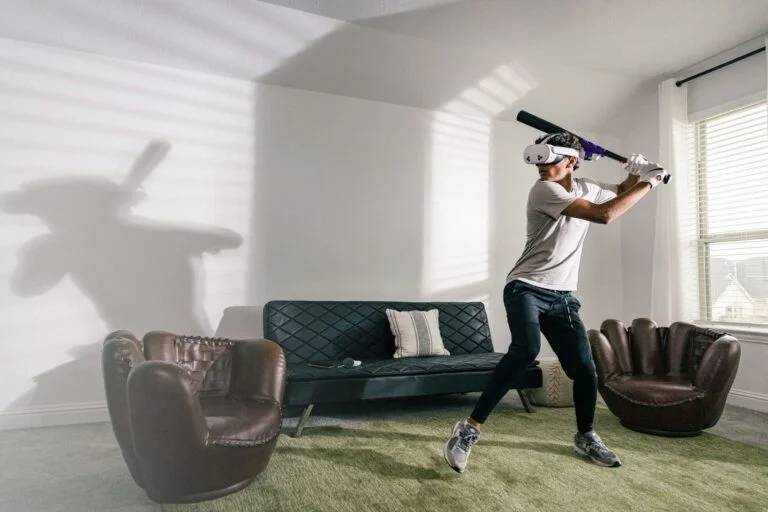
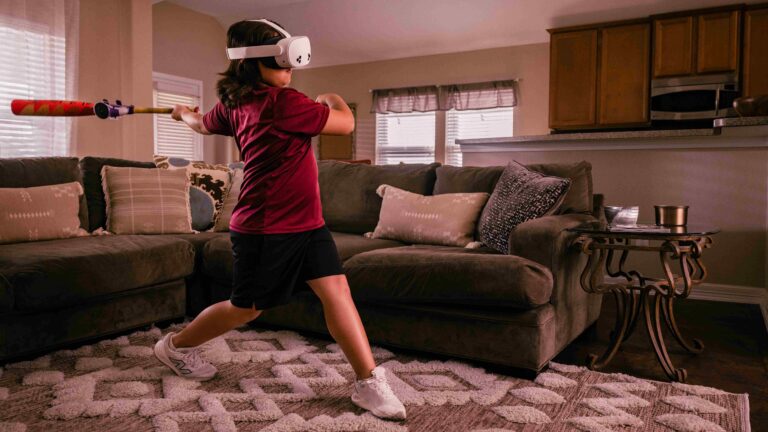
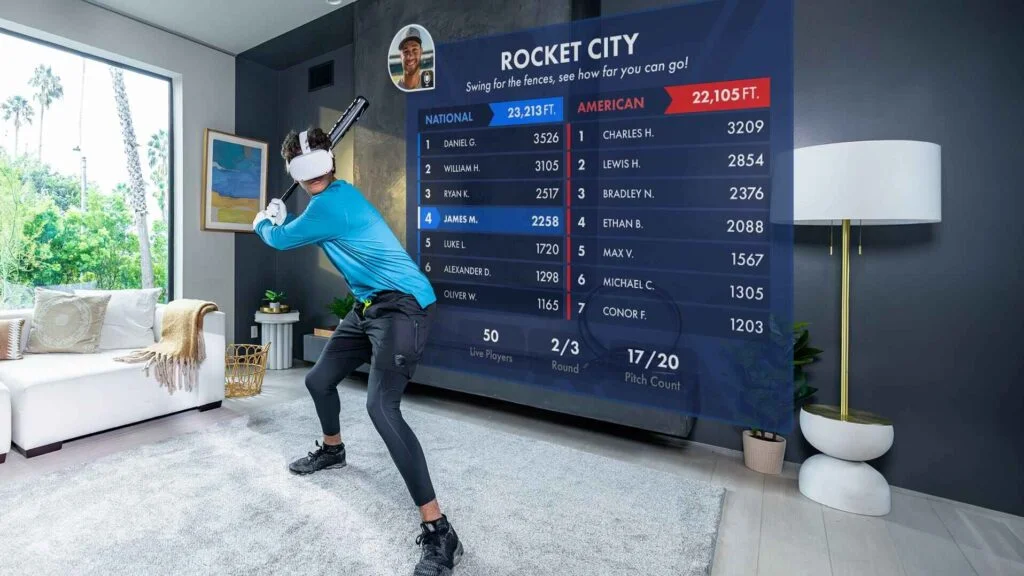
With a Meta Quest headset and a TrainVR subscription, players step into the box and face realistic game-speed pitches from their living room. Fastballs, curveballs, changeups, sliders — all at real velocity and spin. without needing a cage or live pitcher.
What TrainVR trains that drills cannot:
– Pitch recognition: See the ball out of the pitcher’s hand and identify pitch type in milliseconds
– Timing and decision-making: Decide swing or take on every pitch — just like a real at-bat
– Mental reps at game speed: Hundreds of curated workouts for specific scenarios — 0-2 counts, breaking balls, fastball/curveball tunneling, and more
– Structured progression: Multi-week Training Tracks with expert-built plans that build skill over time
Pair TrainVR with SwingAI and you cover both sides of development: VR trains your eyes and timing, while AI analyzes your actual swing mechanics from your phone. Upload a swing, get instant feedback on what is working and what to adjust, and track progress over time.
Together, TrainVR + SwingAI give you a complete indoor training system — the game-speed reps drills cannot provide, plus the personalized swing coaching that video alone cannot deliver.
FAQ
Can You Practice Baseball Indoors?
Yes. Hitting, fielding, pitching, and athletic development can all be trained effectively indoors with the right drills and equipment. Tee work, soft toss, wall ball, and bodyweight circuits are staples of indoor training at every level — from youth to professional.
What Is the Best Indoor Baseball Drill?
Tee work is the single most effective indoor drill for hitters. It builds bat path, contact-point awareness, and mechanical consistency with zero setup complexity. For a complete indoor session, combine tee work with soft toss and 5 minutes of athletic development.
How Do You Keep a Baseball Player Sharp in the Off-Season?
Consistency beats intensity. Train 4-5 times per week with a structured 30-minute indoor routine that covers hitting, defense or pitching, and athleticism. Add TrainVR for game-speed pitch recognition reps that traditional indoor drills cannot replicate — players who train in VR during the off-season see measurable improvements in timing and decision-making when the season starts.
At What Age Should Kids Start Indoor Baseball Training?
Players as young as 6-7 can begin basic indoor drills like tee work, soft toss, and wall ball with age-appropriate equipment (lighter bats, wiffle balls, foam balls). Structured plyometrics and overload/underload training are best introduced at age 12-13. The key at every age: keep reps high, keep sessions short, and make it fun.