Bad weather, short days, or no field access…none of it has to slow your development. The best softball players train year-round, and the off-season is where the biggest jumps happen. Indoor softball drills keep your mechanics sharp, your timing locked in, and your confidence growing, all without needing a full diamond.
Whether you are a youth player building fundamentals, a high schooler chasing a roster spot, or a coach running winter workouts, this guide gives you 15 drills you can run in a gym, garage, or living room.
The Short Answer
Here are 15 indoor softball drills organized by skill:
Hitting (6 drills): Tee Work Progression, Front Toss, One-Hand Drills, Overload/Underload Swings, Softball Swing Path Drill, High-Low Tee Drill
Pitching (4 drills): Towel Drill, Wall Target Drill, Wrist Snaps, K-Posture Mechanics Drill
Fielding (3 drills): Bare-Hand Grounders, Short-Hop Wall Ball, Glove-to-Hand Transfer Drill
Baserunning and Athletic Development (2 drills): Reaction Ball Starts, Lateral Shuffle Agility Series
Keep reading for step-by-step breakdowns, age-specific guidance, and a sample weekly practice plan.
What You Need
You do not need a full facility. Most of these drills work with basic gear in a small space:
- Batting tee (adjustable height)
- Wiffle balls or soft-toss balls (for indoor safety)
- Hitting net or pop-up backstop
- Resistance bands (light and medium)
- Agility cones or markers (4-6)
- Towel (for pitching drill)
- Reaction ball (rubber, irregular bounce)
- Overload/underload bat set or donut weight
- Glove and softballs (for fielding)
- Meta Quest headset (optional, for VR training with TrainVR)
Most items fit in a single bag. If space is tight, prioritize the tee, net, and wiffle balls. Those three unlock half the drills on this list.
Indoor Softball Hitting Drills
Hitting is where indoor work pays off the most. Repetition builds muscle memory, and you do not need live pitching to make real gains.
1. Tee Work Progression
Set the tee at three heights (low, middle, and high) and hit 10-15 balls at each zone. Focus on driving through the ball with a level or slightly upward path. Softball hitters should emphasize staying through the zone longer than baseball hitters because the pitch plane arrives on a different angle from underhand delivery.
Age guidance: Youth players (10U-12U) should start with middle zone only and work on consistent contact. High school and college players should add inside/outside placement at each height for a full nine-zone progression.
2. Front Toss
A partner kneels 10-12 feet in front of the hitter (behind an L-screen or net) and flips wiffle balls into the strike zone. The hitter works on timing and bat path. Keep tosses consistent. This is about the hitter’s rhythm, not the tosser’s creativity.
Age guidance: Youth players can use underhand lobs from 8 feet. Older players should increase speed and vary location to simulate game conditions.
3. One-Hand Drills
Using a lighter bat or training bat, take swings with only the top hand, then only the bottom hand. Five reps each. Top-hand drills build extension and follow-through. Bottom-hand drills reinforce connection and bat control through the zone.
Age guidance: Best for players 12U and up. Younger athletes should focus on two-hand fundamentals first.
4. Overload/Underload Swings
Alternate between a heavier bat (overload) and a lighter bat (underload) in sets of five swings each. Overload builds strength. Underload trains bat speed. The contrast between the two accelerates neuromuscular adaptation. Your body learns to move the game bat faster.
Age guidance: Middle school players can start with small weight differences (1-2 oz). High school and college hitters can use dedicated overload/underload training bats.
5. Softball Swing Path Drill
Place the tee at belt height and set a second ball (or cone) six inches behind and slightly below the contact point. The goal: swing without hitting the back marker. This trains the slightly upward, through-the-zone path that matches the underhand pitch plane unique to softball.
This is one of the most important softball-specific adjustments. Baseball swing paths tend to be steeper and shorter through the zone. Softball hitters need to stay on plane longer because the ball arrives from below, not above.
Age guidance: All ages. Adjust the gap between the tee ball and back marker: wider for beginners, tighter for advanced hitters.
6. High-Low Tee Drill
Set two tees side by side, one at the top of the strike zone, one at the knees. Alternate hits between the two without pausing. This trains quick mechanical adjustments and reinforces how your hands and posture need to change across the zone.
Age guidance: 12U and up. For younger players, use only one tee at a time and alternate heights between sets.
Indoor Softball Pitching Drills
Pitching is the one position that can improve dramatically indoors. Underhand mechanics are repetition-driven, and most drills need nothing more than a wall and a few feet of space.
7. Towel Drill
Hold a hand towel in your pitching hand and go through your full windmill motion. At the release point, snap the towel forward. You should hear a sharp pop. No pop means your wrist snap or release timing is off. This builds arm speed, release-point consistency, and core engagement without stressing the arm.
Age guidance: All ages. One of the best warm-up drills for youth pitchers because it develops mechanics with zero arm load. Aim for 15-20 reps per session.
8. Wall Target Drill
Tape a strike-zone box on a wall (approximately 17 inches wide by 24 inches tall). Stand at your regulation pitching distance and throw into the target. Track how many of 20 pitches land in the zone. Set a baseline and work to beat it each session.
Age guidance: Adjust distance for age: 35 feet for 10U, 40 feet for 12U, 43 feet for high school and college. Use softer training balls indoors to reduce bounce-back risk.
9. Wrist Snaps
Kneel on one knee facing a partner or wall from 10-15 feet away. Using only your wrist and forearm, snap the ball forward with a tight spin. This isolates the release-point snap that generates speed and movement on every pitch type.
Age guidance: All ages. This is a foundational drill. Even college pitchers use it daily. 20-30 reps per session.
10. K-Posture Mechanics Drill
Start in the power position, pitching arm back, stride foot forward, hips open. From this static position, drive through the release and finish. Removing the windup isolates the most critical phase of the pitch: hip drive, trunk rotation, and release. Film yourself from the side to check posture.
Age guidance: Best for 12U and up. Younger pitchers should master the full motion before isolating phases.
Indoor Fielding Drills
Fielding indoors is about hands, footwork, and reaction speed. You do not need a full infield, just a flat surface and a wall.
11. Bare-Hand Grounders
Roll or bounce ground balls to a partner (or off a wall) and field them with your bare hand. No glove forces soft hands, proper fielding position, and watching the ball all the way in. Start slow and increase speed as technique improves.
Age guidance: All ages. Youth players should start from 10-15 feet. Older players can increase distance and speed. 20-30 reps per session.
12. Short-Hop Wall Ball
Stand 8-10 feet from a wall and throw a ball low against the base of the wall so it bounces back as a short hop. Field it cleanly and reset. This trains the most difficult play in softball fielding, reading the hop and getting your glove to the right position.
Age guidance: 10U and up. Vary your throws to create different hop distances. For advanced players, add a lateral shuffle between reps.
13. Glove-to-Hand Transfer Drill
A partner feeds soft grounders or flips from 10 feet. Field the ball and transfer from glove to throwing hand as fast as possible, then simulate a throw. Time yourself. Aim to shave tenths of a second off your transfer. Quick transfers are the difference between outs and base hits at every level.
Age guidance: All ages. Use a stopwatch to track improvement. Youth players should prioritize clean transfers over speed.
Indoor Baserunning and Athletic Development Drills
Speed and agility are trainable and a gym or garage is one of the best places to build them.
14. Reaction Ball Starts
Stand in a base-stealing stance. Have a partner drop or toss a reaction ball (an irregular-bounce rubber ball) from waist height. Sprint to catch it before the second bounce. This trains first-step quickness, reaction time, and explosive starts, the three things that separate good baserunners from great ones.
Age guidance: All ages. Younger players can use a tennis ball for more predictable bounces. Advanced players should add directional cues (partner points left or right before the drop).
15. Lateral Shuffle Agility Series
Set four cones in a line, 5 feet apart. Shuffle laterally through the cones and back, staying low in an athletic position. Do three sets of four trips. Rest 30 seconds between sets. Add a ground-ball field at the end of each trip to combine agility with fielding mechanics.
Age guidance: All ages. Focus on staying low. Players who rise up between cones lose speed and position. Time each set and track improvement.
Sample Weekly Indoor Practice Plan
This plan works for a 60-90 minute session, three days per week. Adjust drill counts based on age and available time.
| Day | Focus | Drills | Duration |
|---|---|---|---|
| Monday | Hitting + Athletic Development | Tee Work Progression, Front Toss, Overload/Underload Swings, Lateral Shuffle Agility Series | 60-75 min |
| Wednesday | Pitching + Fielding | Towel Drill, Wall Target Drill, Wrist Snaps, Bare-Hand Grounders, Short-Hop Wall Ball | 60-75 min |
| Friday | Full Combo | Softball Swing Path Drill, High-Low Tee Drill, K-Posture Mechanics Drill, Glove-to-Hand Transfer, Reaction Ball Starts | 60-75 min |
Youth (10U-12U): Reduce to 2 days per week. Shorten each drill to 10-15 reps. Focus on fundamentals over intensity.
Middle School (13U-14U): Run the full 3-day plan. Add 5 minutes of VR training with TrainVR on hitting days to build pitch recognition.
High School and College: Run 3-4 days per week. Increase rep counts by 25-50%. Add film review and SwingAI analysis after each hitting session to track swing metrics over time.
VR Training: The Indoor Edge
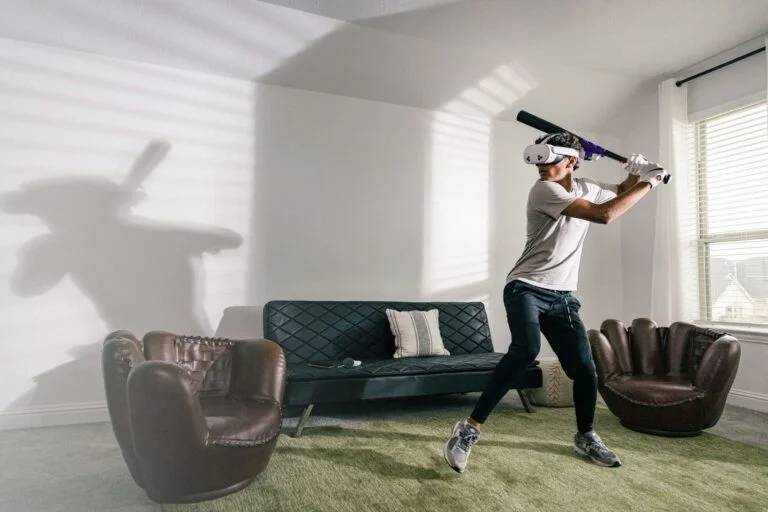
TrainVR puts you in the batter’s box against game-speed pitching on a Meta Quest headset, adding the pitch recognition and timing reps that indoor drill work alone cannot supply.
TrainVR puts you in the batter’s box against game-speed pitching on a Meta Quest headset. No cage, no live pitcher, no weather dependency. Softball players can train against realistic underhand delivery, read spin and speed out of the pitcher’s hand, and make swing-or-take decisions on every pitch.
Here is how it fits into your indoor routine:
- Pitch Recognition Drills: See pitches at game speed and identify pitch type before the ball reaches the plate. Hitters who recognize pitches earlier hit with more authority and chase fewer bad pitches.
- Timing Training: TrainVR lets you face hundreds of pitches per session. That volume of reps is impossible to replicate with live pitching alone. More reps at game speed means your timing stays sharp through the entire off-season.
- Scenario-Based Workouts: Train specific counts and situations: 0-2 approach, runner on third with less than two outs, 3-1 hitter’s count. These curated workouts build the game IQ that separates varsity starters from the bench.
Pair VR sessions with SwingAI for complete development. After a hitting session, upload your swing video and get instant AI-powered feedback on mechanics, bat path, and areas to improve. SwingAI gives you a personalized training plan so every session builds on the last.
The combination (physical drills for mechanics, TrainVR for pitch recognition and timing, SwingAI for swing analysis) gives softball players a complete indoor development system covering mechanics, timing, and pitch recognition in one routine.
FAQ
Can You Practice Softball Indoors?
Yes. Hitting, pitching, fielding, baserunning, and pitch recognition can all be trained effectively indoors. A gym, garage, or large basement with 15-20 feet of open space is enough for most drills. Use wiffle balls or soft-toss balls for safety, and set up a net to contain hits.
What Equipment Do I Need for Indoor Softball Training?
At minimum: a batting tee, wiffle balls, and a hitting net. That covers all six hitting drills in this guide. Add a glove, reaction ball, and agility cones to unlock fielding and baserunning work. For pitching, all you need is a towel and a wall. A Meta Quest headset with TrainVR adds VR pitch recognition training.
How Often Should Softball Players Train Indoors?
Two to four sessions per week during the off-season. Three sessions is the sweet spot for most players. It is enough volume to make real gains without overtraining. Alternate between hitting-focused and pitching/fielding-focused days. Add VR training on hitting days for pitch recognition work.
Are Indoor Drills Different for Softball vs. Baseball?
Yes, in a few key areas. Softball hitters need to stay on the swing plane longer because the underhand pitch arrives from a lower angle. The Softball Swing Path Drill in this guide targets that specific adjustment. Pitching drills focus on windmill mechanics and underhand release. Baserunning and fielding fundamentals are largely the same across both sports.