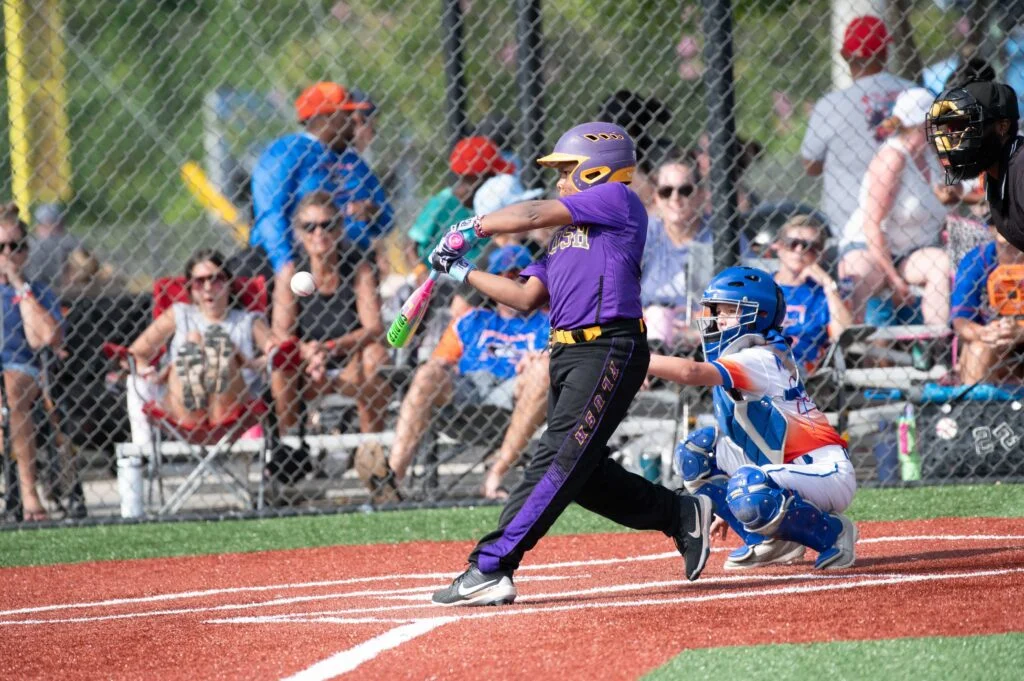
Your 12-year-old just crushed a ball off the tee, checked the radar, and saw “62 mph.” Then his teammate hit 71 and his face dropped. That number is exit velocity, and if you understand what it actually measures, you can turn a discouraging reading into a development plan.
This page breaks down what exit velocity means, how it gets measured, and why repeatable hard contact matters more than one big number for youth hitters. If you want age-by-age targets, we cover those in our exit velocity by age guide, but start here first so the numbers actually mean something.
The Short Answer: What Is Exit Velocity in Baseball?
Exit velocity is the speed of the baseball as it leaves the bat immediately after contact, measured in miles per hour.
As MLB’s Statcast glossary defines it, exit velocity is how hard, in miles per hour, a ball was hit by a batter.
Harder contact matters because it gives fielders less time to react and turns more batted balls into hits. As Wikipedia’s exit velocity entry notes, batters generally aim for higher exit velocity to give opposing fielders less time to react and attempt a defensive play, though many batters still accrue hits without elite exit velocity.
The metric went mainstream in pro baseball a decade ago. Exit velocity was first tracked by Major League Baseball in 2015 with the introduction of Statcast. For reference, the 2022 MLB average sat right around 89 mph, so youth numbers in the 40 to 70 mph range are exactly where they should be.
Bottom line: high EV signals loud contact, but it is one input, not the whole hitter.
What Exit Velocity Tells You About a Hitter
A 10U player hitting 45 mph off a tee and a high schooler hitting 90 mph in a game are being measured with the same metric, but the number means very different things. Exit velocity tells you how much energy transferred from the bat into the ball at contact. It does not tell you if the pitch was a fastball or a tee ball, if the hitter guessed right, or if the swing decision was any good.
That is why you read the number in context, not isolation.
A. Exit Velocity vs. Bat Speed
Parents mix these up constantly, so let’s separate them. Bat speed is the input, and exit velocity is the outcome.
- Bat speed is how fast the barrel is moving through the zone at contact.
- Exit velocity is the result of that speed plus barrel accuracy, timing, and the speed of the incoming pitch.
You can swing 70 mph and still produce weak contact if you catch the ball off the end or get jammed. In WIN Reality’s framework, bat speed lives inside the Three Pillars of Good Hitting alongside Bat-to-Ball skill and Swing Decisions, and EV only climbs when all three work together.
Pitch speed matters too. A faster incoming pitch can add a few mph of “free” exit velocity compared to a tee, since the ball already carries momentum into the collision. That is exactly why a tee number and a live number are not the same test.
Checkpoint: if bat speed is climbing but EV is flat, your hitter has a barrel accuracy problem, not a strength problem.
B. Max Exit Velocity vs. Average Exit Velocity
Here is where most youth families chase the wrong target. Max exit velocity is your single hardest-hit ball. Average exit velocity is what you produce across many swings.
Average exit velocity is calculated by dividing the sum of all exit velocities by all batted ball events. One 71 mph rocket off the tee is a max. Twenty swings averaging 63 mph tells you far more about the hitter you actually are on Saturday.
Why average wins for development:
- A single max reading can come from one perfect guess or one grooved tee ball.
- Average EV rewards repeatable barrel contact, not one lucky swing.
- Even in the big leagues, consistency is the marker analysts watch — average exit velocity captures how consistently a hitter produces loud contact, not just their ceiling.
Track your hitter’s average across a 15 to 20 swing session, not their one best ball. That is the number that shows real progress.
C. Why Exit Velocity Matters for Youth Players
A 12-year-old at 5-foot-2 and 90 pounds who hits 40 to 50 mph but struggles to make consistent contact does not have an exit velocity problem. He has a bat-to-ball and timing problem, and chasing a bigger EV number will not fix it.
Used correctly, exit velocity helps youth hitters in three ways:
- Confidence: a visual, measurable number gives young players proof that hard work is showing up.
- Development tracking: watching your average climb from 45 to 52 mph over a season is honest feedback.
- Effort you can see: data turns “swing harder” into something concrete a kid can chase.
But here is the trap. Exit velocity becomes a vanity metric the second it makes a 10 to 13U player feel “behind.” Puberty, body size, and late growth swing these numbers wildly, and a smaller kid is not worse, just younger physically. A discouraged hitter loses more than a few mph — confidence and mechanics are connected, and a kid who feels behind often starts overswinging to compensate, which makes the number worse, not better.
Keep it in perspective with WIN Reality’s age-based development model:
- Youth (8 to 12): prioritize contact, athleticism, and fun over max EV.
- Middle School (13 to 14): begin tracking averages as strength develops.
- Advanced (15 to College): EV becomes a real recruiting and performance signal.
The goal at every age is repeatable hard contact against real pitching, not one screenshot for the group text.
Ready to turn understanding into game-speed hard contact?
How Exit Velocity Is Measured
A dad on a forum posts that his 12U son tops out at 58 mph off a 31/28 BBCOR and asks if that’s bad. The honest answer: it depends entirely on the setup. Bat type, pitch type, and the tracking tool all move the number, which is why comparing your reading to a random online chart is often apples to oranges.
Before you trust any EV number, lock down the variables:
- Bat type: USA, USSSA, BBCOR, and wood all produce different readings.
- Pitch type: tee, front toss, or live pitching changes the input speed.
- Tool: radar, HitTrax, Rapsodo, or a simulator each measure differently.
MLB uses stadium-grade tracking to get its numbers, and it’s worth knowing the system has changed. From 2015 through 2019, Statcast relied on TrackMan Doppler radar for ball-flight data. In 2020, MLB switched entirely to the Hawk-Eye optical camera system with 12 synchronized cameras per ballpark, with five high-frame-rate cameras (upgraded from 100 to 300 frames per second in 2023) dedicated to pitch and bat tracking, and the other seven tracking players and batted balls. That upgrade is also what let MLB add bat speed and swing path data starting in 2023. Your youth setup will not match that, so consistency in your own testing matters more than the absolute figure.
Method 1: Tee Exit Velocity Test
The tee is your controlled baseline. There is no pitch speed, no timing, and no movement, so you isolate barrel accuracy and bat speed.
Use it to:
- Establish a clean baseline you can repeat weekly.
- Test swing changes without pitch variables muddying the data.
- Build confidence for younger hitters (8 to 12).
The limitation: a tee removes timing entirely, so it tells you almost nothing about game transfer. A big tee number and a quiet game bat is a common story. Retest off the same tee, same bat, every two to three weeks.
Method 2: Front Toss or Batting Practice Exit Velocity Test
Now you add a moving ball, which means timing enters the equation. Front toss and coach BP readings sit closer to real hitting than a tee.
Watch these variables:
- Pitch speed: slower BP inflates or deflates EV depending on contact quality.
- Location: middle-middle produces higher numbers than a ball on the edges.
- Consistency: same tosser, same distance, same bat, every session.
Front toss tells you if your hitter can time up a moving ball and still square it. Log the average of 15 swings, not the best one.
Method 3: Game-Like or Technology-Tracked Exit Velocity
This is the reading that actually predicts game performance, because it adds pitch recognition and true timing. Tools like SmartPark, HitTrax, Rapsodo, and TrackMan capture EV against live or simulated pitches, giving you context a tee never can.
Why this method matters most:
- It measures hard contact against game-speed pitch velocity and movement.
- It forces real swing decisions instead of grooved reps.
- It reveals whether EV holds up when the hitter has to recognize the pitch first.
You do not need stadium-grade gear to apply the principle: the more game-like the test, the more the number means. Prioritize EV readings taken against pitches your hitter has to recognize and time.
How WIN Reality Helps
The gap in most exit velocity training is obvious once you see it: kids build bat speed and tee numbers, then struggle when a real pitcher makes them recognize and time the ball. WIN Reality closes that gap by training hard contact against game-like pitching, not grooved reps.
TrainVR puts your hitter in a Meta Quest headset facing 600+ virtual pitchers at game speed, from home. That is where repeatable exit velocity is actually built.
Use these tools to turn EV understanding into results:
- VR pitch recognition: Pitch Recognition, Release Point, and Recognition Window drills train the eyes to identify pitches early.
- Game-speed reps: face live-speed arms without a field, a coach, or a cage.
- Swing decision training: scenario workouts like 0 to 2 approach, 3 to 2 counts, and 2-strike approach teach hitters to barrel pitches they can actually punish.
- Performance tracking: monitor progress across multi-week Training Tracks.
- At-home environment: stack reps daily, not just at weekend practice.
Want swing-specific feedback too? SwingAI analyzes your uploaded swing video across 12 biomechanical dimensions, from Pelvis Load to Hip Shoulder Separation at Contact, then delivers personalized cues and an improvement plan. That connects the mechanics to the metric.
For age targets and next steps, pair this page with our exit velocity by age resource. The two-strike math alone is worth it: league average drops to .165 with two strikes, and cutting swing-and-miss can mean 15 to 20 more hits per season.
Train the recognition, timing, and swing decisions that make hard contact repeatable, and the exit velocity follows.