Every offseason, a parent asks me the same thing: “My kid has a headset and 20 minutes a night. What actually makes them better?” The honest answer is that most “VR sports” apps are games or workouts, not training programs.
In this guide, I compare the true athlete-development platforms of 2026 by sport, transferable skill, setup, cost, and best-fit user, so athletes, parents, coaches, and facilities can pick the right tool. A VR sports training program is structured, rep-based, and built to transfer to real play, not just entertain. For baseball and softball hitters, WIN Reality leads the category.
Quick Answer: The best VR sports training program in 2026 is WIN Reality TrainVR for baseball and softball hitters, with sport-specific alternatives leading in soccer, hockey, and multi-sport cognition.
Here is how it breaks down by use case:
- Best for baseball/softball hitters: WIN Reality TrainVR, with 600+ virtual pitchers and game-speed reps at home.
- Best for soccer scanning and decisions: Be Your Best.
- Best for hockey and tennis reaction training: Sense Arena.
- Best multi-sport perception and coordination: Rezzil.
The tools that win are the ones built around structured skill reps, not calorie burn or leaderboards. If your hitter needs to recognize pitches and make faster swing decisions at game speed, TrainVR is the clear starting point. The rest of this guide shows you why, and how to evaluate any program before you buy.
Note: for a narrower, apps-focused comparison specifically within baseball (SwingAI vs. Blast, Diamond Kinetics, V1, and others), see Best Baseball Training Apps 2026.
Best VR Sports Training Programs 2026 Compared
A goalie who freezes on a 90 mph shot and a hitter who is late on a 78 mph curveball have the same core problem: their brain is not processing speed fast enough. Below I compare the true training platforms by sport, skill focus, transfer potential, setup, cost, and best-fit user. These are development tools, not games.
A. WIN Reality TrainVR: Best for Baseball and Softball Hitters
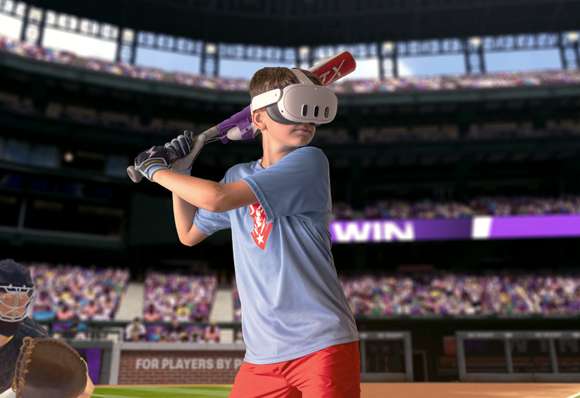
Most hitters get about 15 to 40 quality at-bats a week during the season, and far fewer in winter. TrainVR closes that gap by giving your hitter game-speed reps at home, any night of the week, on a Meta Quest headset.
The platform is built around the two skills that separate hitters: pitch recognition and swing decisions. Those are two of the Three Pillars of Good Hitting, alongside bat speed, and they are exactly what VR trains well.
Here is what your hitter actually reps in TrainVR:
- 600+ virtual pitchers so hitters see real arm slots, release points, and pitch mixes.
- Pitch Recognition, Release Point, Disappearing Pitch, and Recognition Window drills that train the eyes to read spin and location early.
- Scenario workouts for 3-2 counts, 0-2 approach, and a 2-strike approach, plus fastball/curveball tunneling.
- Batting Practice and Exhibition Mode for timing and full at-bats.
- Multi-week Training Tracks that build a routine instead of random reps.
This matters because league average drops to roughly .165 with two strikes. Cutting swing-and-miss in those counts can add 15 to 20 hits over a season, and strike-zone discipline is trainable in VR without a live arm.
Best fit: players 8 through college, parents building at-home routines, and coaches who want measurable swing-decision reps. Pair VR reads with cage work so the physical swing stays clean.
Coach’s takeaway: use TrainVR for recognition and timing, then finish on a tee or in the cage so mechanics do not drift. Start your TrainVR reps here.
B. Be Your Best, Sense Arena, and Rezzil: Best Sport-Specific Alternatives
Not every athlete swings a bat. If your athlete plays soccer, hockey, or tennis, three platforms lead their lanes in 2026.
Be Your Best: Best for soccer. It trains scanning, head-check frequency, and decision speed before the ball arrives. This fits players 9 and up who lose the ball because they stop looking up the field, and it works in a small living-room space.
Sense Arena: Best for hockey and tennis. It targets reaction time, anticipation, and cognitive load under pressure, which is why goalies and skaters use it in the offseason. Expect to budget for advanced drill tiers, since deeper training modules often cost extra beyond the base subscription.
Rezzil: Best multi-sport perception and coordination. It runs reaction, coordination, and decision challenges used across pro academies. Use it as a general athletic-cognition tool for athletes 13 and up, not as a substitute for sport-specific mechanics.
Match the platform to the sport’s core skill. Scanning for soccer, reaction for hockey and tennis, and general perception for multi-sport athletes. Then confirm each program has real drills, not just highlight-reel visuals.
C. VR Sports Games and Fitness Apps: Useful, but Not the Same as Training Programs
Here is where most buyers get burned. A parent sees a $20 boxing or golf app rated 4.5 stars and assumes it will build real skill. It builds sweat and fun, not transfer.
VR fitness apps like rhythm boxing and cardio titles are genuinely good for conditioning and offseason movement. They are motivating and low-cost. But they do not train sport-specific reads, timing windows, or decision-making under game pressure.
Games help in three narrow ways:
- Conditioning and cardio during the offseason, 20 to 30 minutes a session.
- Basic hand-eye coordination and reaction, useful for athletes 8 and up.
- Feel and fun, which keeps kids engaged with the headset.
Where they fall short: no structured progression, no skill-transfer data, and unrealistic in-game outcomes that can teach bad habits. Treat games as a warm-up, not the workout.
If the app measures calories instead of skill reps, it is fitness, not training. Choose a structured program for development.
Want game-speed pitch recognition and swing-decision reps at home? TrainVR gives your hitter 600+ virtual pitchers and scenario workouts built to transfer to the plate.
Tools and Methods: How to Evaluate the Best VR Sports Training Programs in 2026
A dad in Northern Illinois told me his cage closes for five months a year and he wanted to know if VR was “legit or a gimmick.” That is the right question. Use this three-part framework before you spend a dollar.
Method 1: Match the Program to the Skill You Want to Improve
The fastest way to waste money is buying a tool that trains the wrong skill. Start by naming the exact gap in your athlete’s game.
Match the skill to the platform:
- Pitch recognition, timing, strike-zone judgment: WIN Reality TrainVR.
- Scanning and tactical decisions (soccer): Be Your Best.
- Reaction time and anticipation (hockey, tennis): Sense Arena.
- Visual tracking and multi-sport perception: Rezzil.
- Conditioning only: a VR fitness app, 20 to 30 minutes per session.
VR trains perception and decisions extremely well because it delivers hundreds of reps at game speed. It does not build the physical swing on its own. For mechanics like the Load Phase, hip-shoulder separation, and the forward move, you still need a tee, cage, and coach.
Write down the one skill you want in 90 days, then buy the tool that reps it daily.
Method 2: Grade the Evidence and Real-World Transfer Claims
Every VR brand claims results. Your job is to grade the evidence, not the marketing.
Sort claims into four tiers:
- Peer-reviewed research: strongest. A growing body of published VR sports-training studies examines skill transfer to real play.
- Internal performance data: useful when the sample is large and the metric is real.
- Coach adoption: meaningful when programs and academies use it in-season.
- Testimonials: weakest, treat as anecdote.
Be honest about limits. VR reps sharpen recognition and timing, but a hitter can still groove a bad swing if nobody watches mechanics. That is why WIN pairs VR reads with SwingAI biomechanic analysis, so the physical swing gets checked too.
Demand at least coach adoption plus internal data before you buy, and never rely on testimonials alone.
Method 3: Calculate Total Cost, Setup, and Consistency Requirements
The sticker price is never the real price. Add up the full cost of ownership before you commit.
Budget for all of it:
- Headset: a Meta Quest runs a few hundred dollars if you do not already own one.
- Subscription: ongoing monthly or annual cost.
- Accessories: a sport-specific bat or attachment.
- Space: boxing and full-swing apps need room; a 6-by-5-foot area is too tight for big movements.
Then account for the hidden factor: consistency. A headset in the closet builds nothing. Set a schedule of 3 to 4 sessions per week, 15 to 20 minutes each, and have a parent or coach hold the athlete accountable.
Pick the program your athlete will actually use 3 times a week for 12 weeks, not the flashiest demo.
How WIN Reality Helps
Picture a 14-year-old who is late on every fastball above 80 mph in March. He has not seen live pitching since October. That is the exact problem WIN Reality TrainVR solves.
TrainVR turns a Meta Quest into a hitting simulator with 600+ virtual pitchers, so your hitter faces real velocity, arm slots, and pitch mixes at home. It trains the skills VR does best: pitch recognition, swing decisions, strike-zone discipline, and timing, all organized into Multi-week Training Tracks that build habits instead of random reps.
Because two of the Three Pillars of Good Hitting are pitch recognition and swing decisions, VR reps translate directly to better plate discipline. League average falls to about .165 with two strikes, and cutting chase can mean 15 to 20 more hits a year.
To keep mechanics clean, pair TrainVR with SwingAI. Upload a swing video and get instant analysis across 12 biomechanic dimensions, from Negative Move and Pelvis Load to Hip Shoulder Separation at Contact, plus personalized cues.
The simplest path is the Ultimate Hitter Pack, which bundles TrainVR, SwingAI, the WIN bat attachment, and an optional Meta Quest 3S.
Train reads and decisions in VR, verify mechanics with SwingAI, and finish in the cage. That combination beats any single tool.
Start Training
Give your hitter game-speed reps at home this week and turn winter into a competitive advantage.