Get SWINGAI and download the WIN Reality app to analyze your own swing.
Raw Power Meets Rhythmic Precision
When Vladimir Guerrero Jr.’s swing is on display, it’s more than just power, it’s a showcase of elite sequencing, balance, and control. The ball doesn’t just leave his bat, it rockets off with a vengeance. But beneath the brute strength and loud contact lies one of the most biomechanically balanced and efficient swings in baseball.
We’re using SwingAI to evaluate and compare the swings of some of Major League Baseball’s most dangerous hitters. From Vladimir Guerrero Jr. to Shohei Ohtani and Mookie Betts, we’re examining what makes each swing uniquely effective for that player’s approach and offensive style. By analyzing just a single swing, SwingAI provides instant insights across 12 key swing dimensions, making pro-grade analysis faster and more accessible than ever.
Let’s dive into how Vladdy’s swing compares to other MLB superstars and what makes it uniquely dangerous.
Quiet Hips, Loud Results: Balance & Load
Vladimir Guerrero Jr.’s swing isn’t built on exaggerated movement. Compared to Aaron Judge’s massive pelvis rotation, Guerrero uses a more compact coil and a lightning-quick unwind.
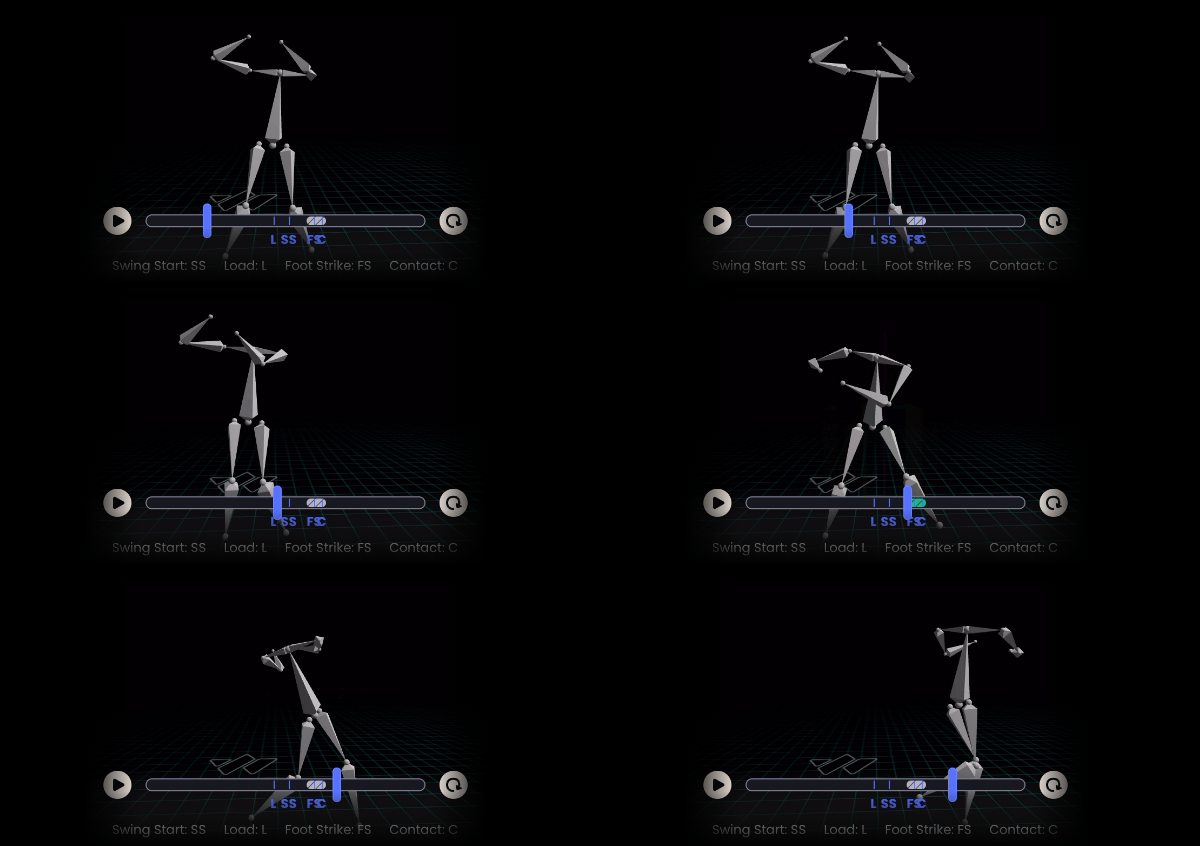
Guerrero Jr.’s swing begins with a strong and deliberate Negative Move, a subtle yet powerful shift of weight back, that helps him load energy like drawing back a slingshot.

Negative Move
This move sets the tone for everything that follows, building a stable base for explosive motion.
While the SwingAI profile shows pelvis load and upper torso load on the lower part of the range, it works to his advantage. Vlad Jr. finds balance through efficient posture and timing. He doesn’t rely on exaggerated movement in the load phase—he’s quiet, grounded, and ready to unleash.

Pelvis Load
Vlad uses a compact, efficient hip coil. He doesn’t over-rotate, keeping his lower half ready to fire.

Upper Torso Load
His torso remains tight with a controlled inward turn, supporting a direct turn to the ball.
Forward Move Magic: Controlled Power Through Space
Vladimir’s forward move scores a perfect 5 out of 5, placing him among elite company like Mookie Betts and Freddie Freeman. This forward move allows him to gain ground efficiently without drifting. It’s a smooth, powerful glide forward that sets up his move to the ball perfectly.

Despite having a larger frame, Guerrero maintains exceptional body control. At foot strike, he shifts his center of mass forward to 46.9%, higher than Judge (40.0%) and nearly identical to Soto (44.2%) and Freeman (44.0%). That balance enables him to stay adjustable against high-velo and off-speed pitches alike.
Stride length is one of the most underrated elements of Vladimir Guerrero Jr.’s swing. With a scaled stride length of 57.3%, he matches Betts (57.4%) and Freeman (57.2%). This allows him to maintain balance while still covering ground.

His early foot strike gives him time to track pitches and adjust. It’s the kind of move that creates success against elite velocity and sharp secondary pitches.
The Engine Behind the Explosiveness: Upper Body Sequencing
What powers Guerrero Jr.’s swing is his elite upper-body sequencing. His torso rotation at max hip-shoulder separation hits -38.0 degrees, nearly identical to Mookie Betts (-40.0) and Aaron Judge (-38.7). This measurement shows just how effectively Vlad stores energy in his upper body and then unleashes it into the swing.

Max Hip-Shoulder Separation
While not the highest in the league, his max separation is timed perfectly. It provides just the right amount of stretch between hips and shoulders, enabling efficient energy transfer.

Upper Torso Direction at Contact
He stays slightly closed at contact, which preserves torque and allows him to delay rotation just enough to maximize bat speed.
The result: Hand speed with a peak of 7.97 m/s, Vlad Jr. sits among the elite in bat speed, a direct result of his upper-body efficiency.
Together, these elements create a whip-like barrel action. Guerrero Jr. doesn’t need massive moves—his swing is built on sequencing, balance, and precise timing. The result? Explosive contact with minimal wasted motion.. It’s the result of synced, sequenced body control—where tension, tilt, and timing come together to deliver a compact yet explosive swing.
How Guerrero Jr. Stacks Up Against Other MLB Superstars
Aaron Judge: The Towering Titan vs. The Rhythmic Bomber
Judge leverages massive hip-shoulder separation and a longer stride to generate extreme exit velocity. Guerrero, on the other hand, trades some of that explosive torque for a cleaner path and more balance.
Juan Soto: Fluid Timing vs. Firm Foundations
Soto’s exaggerated stride gives him supreme adjustability. Vlad’s shorter stride and earlier foot strike allows him to attack more pitch types while staying grounded.
Shohei Ohtani: Rotational Thunder vs. Sequenced Power
Ohtani is all about rotational violence. Guerrero creates similar force with less moving parts, prioritizing efficiency and barrel direction.
Mookie Betts: Speed Meets Efficiency
Betts is quicker and more compact, but Guerrero creates similar output through a stronger frame and excellent sequencing.
Freddie Freeman: Smooth vs. Snappy
Freeman’s long levers and fluid swing generate extension-based power. Vlad uses a snappier sequence, ideal for tighter windows.
Vladimir Guerrero Jr. Key Metrics Summary Chart
| Player | Stride Length | Hand Speed | Center of Mass at Foot Strike | Max Hip Shoulder Separation |
|---|---|---|---|---|
| Vladimir Guerrero Jr. | 57.3% | 7.97 m/s | 46.9% | -38.0° |
| Aaron Judge | 47.9% | 7.53 m/s | 40.0% | -38.7° |
| Juan Soto | 66.3% | 8.73 m/s | 44.2% | -35.1° |
| Mookie Betts | 57.4% | 8.77 m/s | 47.2% | -40.0° |
| Shohei Ohtani | 51.8% | 7.54 m/s | 43.3% | -34.8° |
| Freddie Freeman | 57.2% | 8.07 m/s | 44.0% | -31.9° |
Metric Definitions & Context
- Stride Length (% of height): Indicates how much ground the hitter covers during the forward move.
- – Longer strides create more time for separation and torque. Shorter strides aid in quicker adjustments.
- Hand Speed (m/s): Measures how fast the hitter’s hands are moving at peak swing velocity.
- – Higher hand speed translates to faster bat speed and greater exit velocity potential.
- Center of Mass at Foot Strike (%): The percentage of body weight shifted forward when the front foot lands.
- – Higher percentages (like 46.9%) reflect aggressive but balanced forward movement ideal for sequencing into rotation.
- Torso Rotation (°): Degree of upper body coil relative to the hips.
- – More rotation = greater stretch and swing torque.
Final Takeaway: Why the Vladimir Guerrero Jr. Swing Works
The Vladimir Guerrero Jr. swing isn’t flashy—it’s functional, fierce, and fine-tuned for results. His combination of forward momentum, core-driven torque, and precise barrel control creates a swing that’s devastating and durable.
SwingAI doesn’t just highlight his strengths—it shows how his efficient mechanics stack up with the best in the game. From elite torso rotation to balanced movement, Vladimir Guerrero Jr. is proving that his swing isn’t just powerful—it’s perfectly built for today’s game.
Want Your Swing Analyzed Like Vladimir Guerrero Jr.?
Upload your swing to the WIN Reality App powered by SwingAI and get pro-level AI powered swing analysis and recommendations instantly.
Step into the box with confidence. Your swing journey starts now.