Every October, the same thing happens. Team practices dry up, the cages get cold, and your hitter goes four months without seeing a live pitch. By February tryouts, timing is gone and confidence is worse.
That gap is the real reason a baseball training setup at home matters, especially from October through February when outdoor reps disappear in most of the country. The problem is that most parents get buried in gear lists and viral gadgets before anyone asks the right question: what are you actually trying to train?
This guide fixes that. You will build a setup around your space, your budget, and one clear skill, whether you have $75 or $1,000. No wasted money, no equipment you will never use.
You need four things to build a baseball training setup at home: minimum gear that fits your space, a safe swing area, one skill you are actually training, and a clear upgrade path.
Start with a tee, a 7×7 net, and a bucket of limited-flight balls for under $150. Plan for roughly 10 feet of depth, 8 feet of width, and at least 8 feet of ceiling clearance for a basic tee station. Plan for more ceiling height if your hitter takes a full, high-effort follow-through, since a garage or basement with light fixtures, fans, or low beams is a real way to break a bulb or a bat on an otherwise good setup.
From there, match your setup to a goal:
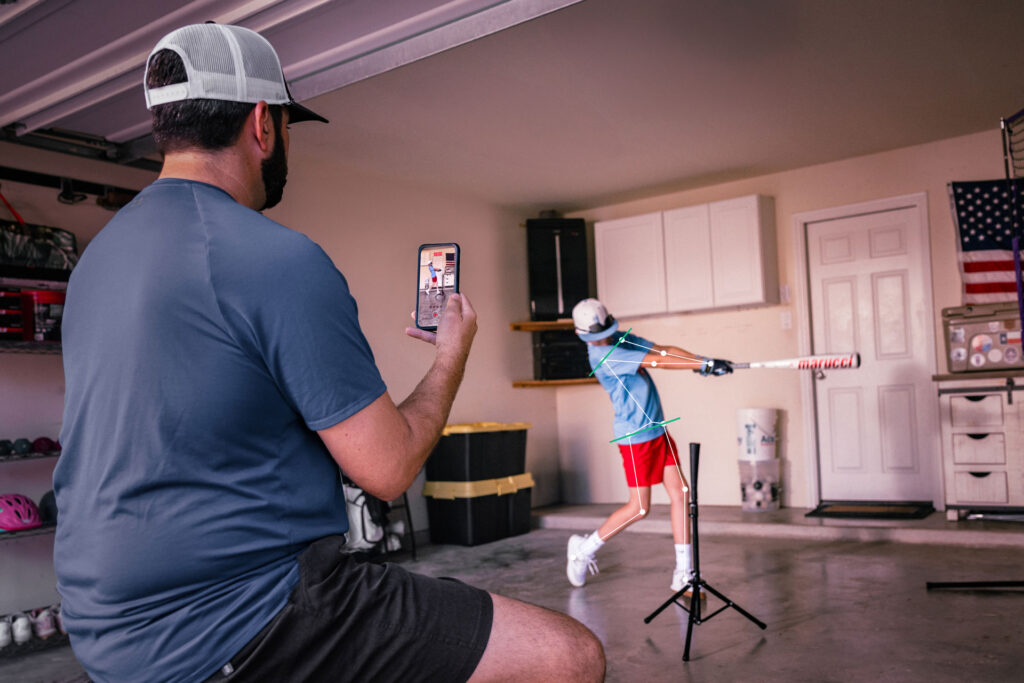
- Swing mechanics and bat speed: tee, net, and video for feedback
- Timing and pitch recognition: VR reps like TrainVR, since a tee cannot move
- Fielding and arm care: rebounder net and a throwing target
The mistake is buying a $600 pitching machine when your hitter actually needs to learn to recognize a curveball. Train the skill first. Buy the gear second.
Build Your Baseball Training Setup at Home Around Space, Budget, and Training Goal
Here is the trap most families fall into. You copy a one-size-fits-all equipment list, spend $400, and three weeks later your kid is bored and the net is folded in the garage.
A setup that gets used starts with three questions, in this order: How much room do you have? What skill are you training? What can you spend? Answer those and the gear picks itself.
A. Start With Your Available Space
Your space decides everything else, so measure before you buy anything. A full swing with a 30-inch bat needs a clear arc of about 7 to 8 feet in every direction, and youth players (ages 8 to 12) still need close to that.
Match the setup to what you actually have:
- Apartment or bedroom: No live balls. Dry swings, mirror work, and VR only.
- Basement: Check ceiling height first. Under 8 feet means no full overhead follow-through with a real bat.
- Garage (single or shared): Great for a tee and net. Watch light fixtures, the garage door track, and cars.
- Driveway or backyard: Room for soft toss and short front toss with limited-flight balls.
- Backyard cage: Batting cages run 35 to 70 feet depending on age and use case. If you’re weighing a real cage, see The Best Backyard Batting Cages for a full buyer’s breakdown before you commit that much space and budget.
Also plan for flooring, lighting, siblings walking through, and supervision for players under 12. Clear the space, then pick the drill.
B. Match the Setup to the Skill You’re Training
This is where most home setups fail. Hitting 100 balls off a tee builds one thing: a repeatable swing. It does nothing for timing or recognizing a slider.
WIN Reality builds hitters on the Three Pillars of Good Hitting: Bat Speed, Bat-to-Ball, and Swing Decisions. Each pillar needs a different tool at home:
- Swing mechanics and bat speed: Tee and net, plus swing video. Train the 4-phase swing (Load, Stride, Swing, Finish) and the Kinetic Chain from pelvis to torso to arms to hands to bat.
- Timing and pitch recognition: You cannot train this on a tee. A stationary ball never moves, so you need live pitch simulation.
- Plate discipline and swing decisions: Same problem. You need to see pitches out of a hand and decide to swing or take.
- Fielding, throwing, and arm care: Rebounder net and footwork ladders, 10 to 15 minutes a day.
Pick one pillar per session. A 20-minute block on a single skill beats an unfocused hour every time.
C. Choose the Right Budget Tier
You do not need to go all in on day one. Build in tiers and let your hitter earn the next upgrade with consistency, not just a birthday.
- DIY (under $100): Tee, foam or limited-flight balls, and a phone tripod. Add mirror work and dry swings for free.
- Starter ($100–$300): Add a 7×7 net and a ball caddy. This covers 80 percent of at-home hitting reps.
- Upgraded ($300–$700): Add a rebounder for fielding, a weighted training bat, and a swing analysis subscription for feedback.
- Premium ($700+): A backyard cage, a pitching machine, or a full VR setup with TrainVR for game-speed reps year round.
The smartest offseason dollar is not always more gear. It is feedback and live pitch reps, which is exactly where the next tier pays off.
Ready to add game-speed reps to any budget tier?
Indoor reps, real pitchers, and timing work all winter. No cage, no machine, no pitcher required.
Tools and Methods: Three Ways to Train at Home
The best offseason plan stacks three things: physical reps to build the swing, decision reps to train the brain, and a feedback loop so you are not grooving bad habits.
Run all three across a week and you cover every pillar. Here is how each one works at home. For more drills beyond these three methods, see Indoor Baseball Drills You Can Do at Home.
Method 1: Tee, Net, and Safe-Ball Station
This is your foundation and your first purchase. A tee, a 7×7 net, and a bucket of foam or limited-flight balls fits a garage or backyard and keeps siblings and windows safe.
Set the net 8 to 10 feet from the tee and check your ceiling clearance before the first swing. Use foam or limited-flight balls indoors so a mishit does not put a ball through drywall.
Run swing checkpoints, not just hacks. Ten quality reps beat 100 sloppy ones:
- Load Phase: Feel your center of mass shift back. Cue: “Back pocket down the line.”
- Stride Phase: Land firm and controlled, no drifting forward.
- Swing Phase: Cue: “Land firm, turn behind your front hip.”
- Finish: Balanced, barrel through the zone.
If the barrel casts out early, run the Stop at Contact Drill with the cue “Short to it, long through it.” Ten reps, then reset.
Method 2: Small-Space Skill Circuit
No yard? Cold climate? A bedroom or a 6-foot corner is enough to keep your hitter sharp through February. This is the setup for apartments, townhomes, and northern winters.
Run a 15-minute circuit with zero live balls:
- Dry swings (10 reps): Full 4-phase swing, no ball, focus on sequencing.
- Mirror work (5 minutes): Watch hip-shoulder separation at foot down. This angle has a target range, not a “bigger is always better” rule. Too little and the swing is arm-dominant with no torque; too much and the hitter is overrotating into what WIN calls a Gate Swing. Watch for a separation that looks athletic and coiled, not maxed out.
- Short-handle or plyo-ball work: Soft foam contact against a wall pad.
- Torque Drill (10 reps): Train hip-shoulder separation directly, building the “coil” that stores rotational power before the hands fire.
- Fielding footwork: Ladder or taped floor lines, 3 to 5 minutes.
This circuit builds real movement patterns in tight space. What it cannot give you is a moving pitch, and that is the gap Method 3 fills.
Method 3: TrainVR Pitch Recognition and Timing Reps
Here is the honest limit of every tee and net: the ball never moves. Your hitter can own a perfect swing in the garage and still freeze on a 70 mph curveball in April because the eyes and timing were never trained.
TrainVR solves that in any room with 8 feet of clearance. It runs on a Meta Quest headset and puts your hitter in the box against 600+ virtual pitchers at game speed, with no cage, machine, or live pitcher needed.
Train the reps you cannot get at home any other way:
- Pitch Recognition and Recognition Window drills to read pitch type early
- Release Point and Disappearing Pitch for tracking
- Scenario workouts: 2-strike approach, 0–2 counts, breaking ball recognition, and fastball/curveball tunneling
That 2-strike work matters. League average drops to around .165 with two strikes, and cutting swing-and-miss can mean 15 to 20 more hits per season. Log 3 to 4 TrainVR sessions a week to keep timing and swing decisions game-ready all winter.
How WIN Reality Helps
Most home setups train the body and ignore the brain. WIN Reality closes that loop by pairing objective swing feedback with live pitch reps, so your offseason actually shows up at spring tryouts.
Two products do the heavy lifting:
SwingAI turns your phone into a hitting coach. Upload a swing video and get instant AI analysis across 12 biomechanical dimensions, from Negative Move and Pelvis Load to Hip Shoulder Separation at Contact.
You get personalized cues, an improvement plan, unlimited analyses, and progress tracking so you can prove the tee work is fixing the swing and not grooving flaws.
SwingAI flags the issues by name. If it shows weak separation or an early forward move, you get a targeted cue and drill instead of guessing.
TrainVR then trains the part a tee never will:
- Pitch recognition and reading pitch type out of the hand
- Timing against 600+ pitchers at real game speed
- Plate discipline and swing decisions in live counts
Run them together and every pillar is covered. SwingAI sharpens the swing, TrainVR sharpens the decision, and both track progress over the full October-to-February window.
Want the complete system in one purchase? The Ultimate Hitter Pack bundles TrainVR and an annual SwingAI subscription into one package. It is the fastest way to turn a garage or spare room into a year-round development environment.
Build a Smarter Setup This Offseason
Do not let four months off cost your hitter a season. Start with the tee and net, add real feedback with SwingAI, and get game-speed timing reps with TrainVR so April feels like you never stopped.