You hit .380 as a senior, your travel coach told you that you had “D1 stuff,” but the phone never rang. Now it’s late summer, rosters are filling, and you’re staring at a choice most recruiting sites gloss over.
JUCO baseball recruiting is not a consolation prize. It’s a real development path that lets you keep playing, get everyday reps, fix your academics, and build the kind of verified proof that four-year coaches trust more than a high school highlight tape.
This guide gives you the plan the big recruiting services skip: how to decide if JUCO fits, what coaches actually evaluate, and how to build proof that earns your next opportunity.
Is JUCO baseball recruiting worth it?
Yes, JUCO is worth it if you need reps, physical development, an academic reset, or stronger, college-tested proof for four-year coaches. It’s the wrong move only if you already have a four-year offer that fits your major and you’ll actually play there.
Here’s the reality that makes JUCO more relevant than ever. Only about 2% of high school baseball players compete at D1, and roughly 7 to 8% play college baseball at any level. The path narrowed further recently: under the House Settlement, opted-in D1 programs now carry a 34-man roster cap that took effect July 1, 2025, so rosters are tighter and your target list needs to be broader and more honest.
JUCO fits you if you check one of these boxes:
- You need everyday at-bats you won’t get riding a four-year bench
- Your body or your bat speed is still 1 to 2 years from a four-year role
- Your GPA or core courses need a reset before a four-year transfer
- You want two years of college stats before deciding your ceiling
What you must do next: build measurable proof, target the right programs, and start outreach now. The rest of this guide shows you how.
How to decide if JUCO baseball is the right recruiting path
Picture two unsigned seniors. One takes a preferred walk-on spot at a D1, sits for two years, and never gets an at-bat. The other goes JUCO, plays 50-plus games, adds real numbers, and transfers up. Same talent, different plan. The decision is about playing time and proof, not prestige.
A. JUCO vs. D2, D3, NAIA, preferred walk-on, and post-grad options
Match the path to your actual goal, not the logo. The timeline at D2, D3, NAIA, and JUCO is dramatically different and a lot more forgiving than the D1 calendar, which gives you room to keep recruiting yourself into the fall.
- JUCO: Best if you want maximum reps plus a clear transfer-up path. When a JUCO athlete completes their two years, they enter the transfer portal as a junior with two years of eligibility remaining. The tradeoff: you have to go through the recruiting process a second time after your two years are complete.
- D2 / NAIA: Good four-year homes with real scholarship money and immediate stability if you’ll play early.
- D3: Strong academic fit, no athletic scholarships, but a four-year degree path without a transfer reset.
- Preferred walk-on (D1): Only worth it if the coach gives you an honest reps timeline. A roster spot with zero at-bats does nothing for your development.
- Post-grad year: A fit for late bloomers who need one more year of physical growth before college recruiting.
Your takeaway: rank playing time, development, cost, academics, and transfer opportunity in your own order, then pick the path that wins on your top two.
B. What JUCO coaches are really evaluating
JUCO coaches move fast and recruit on proof, not projection. JUCO programs often recruit on a rolling basis. An athlete can visit a campus and receive an offer the same week. That means your proof has to be ready before you reach out.
For hitters and position players, coaches want to see:
- Verified measurables: exit velocity, bat speed, and 60-yard time from a showcase or a trusted app, not self-reported guesses
- Game-speed video: at-bats against real velocity, not just tee and front-toss clips
- Swing decisions and pitch recognition: how you handle a 3-2 count and lay off the breaking ball out of the zone
- Academics: transcript, GPA, and core-course standing so they know you’ll be eligible to transfer
- Coachability: references who confirm you take instruction and compete
WIN Reality’s Three Pillars of Good Hitting frame exactly what to develop for that film: bat speed, bat-to-ball, and swing decisions. Build proof in all three and your outreach carries weight.
C. Timeline: what to do in the first 30, 60, and 90 days after no D1 interest
Do not wait. Some programs fill fast, and NJCAA coaches can contact athletes at any time, at any age. There are no dead periods, quiet periods, or contact limitations like the NCAA has.
- Days 1 to 30: Get one verified showcase or updated measurables. Cut a 3-to-4 minute game-speed video. Pull your transcript. Build a 20-to-30 school target list using the NJCAA site.
- Days 31 to 60: Send personalized emails to your top 15 programs. Log every reply. Ask each coach about position needs and open tryouts.
- Days 61 to 90: Schedule 2 to 3 visits, attend a JUCO tryout, and keep training so your numbers climb between contact points.
Your takeaway: treat these 90 days like a season, with weekly reps and measurable progress you can report to coaches.
Ready to build proof coaches can’t ignore? GET STARTED WITH WIN REALITY
How to get recruited by JUCO baseball programs
A senior emailed 40 JUCO coaches with “Baseball Player Highlights” in the subject line and one grainy tee video. Zero replies. The problem wasn’t his swing. It was his package and his process. Fix both and coaches respond.
Method 1: Build a coach-ready recruiting package
Coaches evaluate what they can see. College coaches base their judgments on what they can see, and with thousands of prospects, they cannot attend every game. A complete recruiting profile and a sharp highlight video do the talking when you cannot be there in person.
Your package needs every item in one place:
- Positions and measurables: exit velo, bat speed, 60 time, arm strength, all verified
- Video: a 3-to-4 minute reel that opens with game at-bats, then defense
- Academics: GPA, transcript, and NCAA/NJCAA eligibility status
- Logistics: graduation year, travel team, schedule, and 2 references
- Contact info: your phone and email at the top, easy to scan
Include your positions, measurables, key statistics, academic information, club and high school baseball details, and contact information. Keep everything accurate and easy to scan. Coaches sort through hundreds of profiles, so clarity wins. For the full profile framework, use WIN Reality’s how to get recruited for college baseball guide.
Method 2: Use a JUCO outreach cadence coaches can actually respond to
Volume without a system gets ignored. Build a cadence:
- Subject line: position, grad year, and one number, like “2026 SS / 92 mph exit velo / 6.9 sixty”
- First email: 5 to 6 sentences. Say why that program, list 3 measurables, link the video, attach transcript.
- Follow-up: wait 5 to 7 business days, then send a short bump with any new number or upcoming game.
- Call script: if a coach replies, ask about position need, roster spots, and open tryouts in the first 3 minutes.
- Updates: every 2 to 3 weeks, send fresh proof so your name stays active.
JUCO coaches respond faster than NCAA coaches. Expect to hear back within a week if there is interest. Your takeaway: send first, follow up on schedule, and always attach a new number.
Method 3: Vet the program before you commit
Not every JUCO develops players, and not every JUCO program is equally strong at the transfer piece, even among ones with similar win-loss records. Do the research before you sign, because there is no substitute for quality research on a program you are considering.
Ask each coach directly:
- Roster and cuts: How many do you carry in the fall, and how many get cut?
- Playing time: How many freshmen at my position get real at-bats?
- Transfers: How many players moved on to four-year rosters the last 3 years, and at what level?
- Development plan: What does my day-to-day look like, and how do you track progress?
- Academics: Will my credits and major transfer to the schools I want?
- Costs: What’s the real total after scholarship, including housing and fees?
Cross-check the coach’s answers against public data. As of the 2026 season, 261 JUCO programs across all six governing bodies tracked have 20 or more alumni playing at 4-year programs right now. You can verify a program’s placement record through outside trackers like College Baseball Insights. Your takeaway: commit only when the numbers back up the pitch.
How WIN Reality helps: build the proof JUCO coaches and four-year programs need
The senior who transfers up isn’t the one who talks about his ceiling. He’s the one whose swing decisions and game-speed at-bats show up on film. That’s exactly the proof WIN Reality helps you build between now and your first coach visit.
- TrainVR: Take game-speed reps at home against 600-plus virtual pitchers. Sharpen pitch recognition with the Pitch Recognition, Release Point, and Recognition Window drills, and rehearse 3-2 counts and 0-2 approaches in scenario workouts.
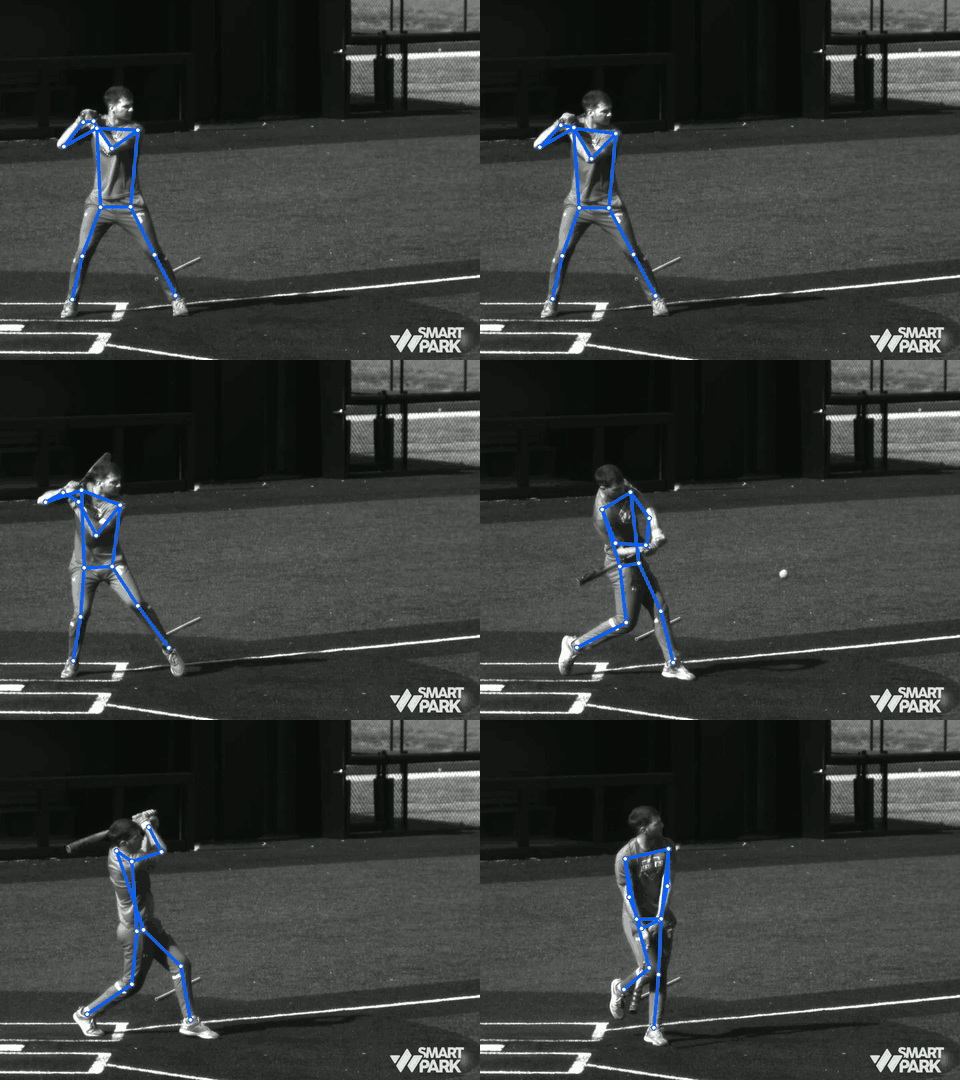
- SwingAI: Upload a swing video for instant analysis across 12 biomechanical dimensions, then get personalized cues and a plan. If your bat speed lags because of weak hip-shoulder separation, the Torque Drill and Knob to Knee Drill target it directly.
- Progress tracking: Unlimited analyses let you document month-over-month gains, which is the proof of recent development coaches ask for.
This is where swing decisions pay off at the plate. WIN Reality’s two-strike framework matters because league average drops to .165 with two strikes, and cutting swing-and-miss can add 15 to 20 hits per season. [NEEDS VERIFICATION: confirm source and add hyperlink for the two-strike batting average and hits-per-season figures before publishing.] That’s the difference on a JUCO stat line four-year coaches watch.
Pair this training with a real calendar. Map your outreach against WIN Reality’s college baseball recruiting timeline so you’re contacting programs when spots are still open. For the fastest ramp, the Ultimate Hitter Pack bundles TrainVR, SwingAI, and the bat attachment in one package.
Train like a recruit who has a plan
Overlooked isn’t the same as done. The players who transfer up are the ones who keep developing, keep their numbers climbing, and put verified proof in front of the right JUCO coaches before rosters fill. Build that proof now, then hit send on your outreach.