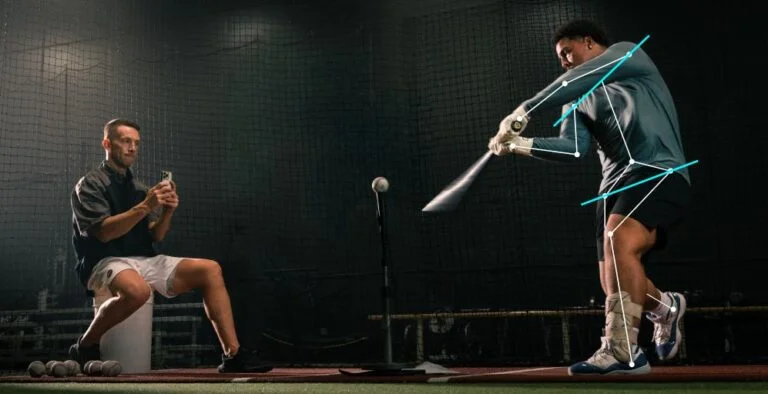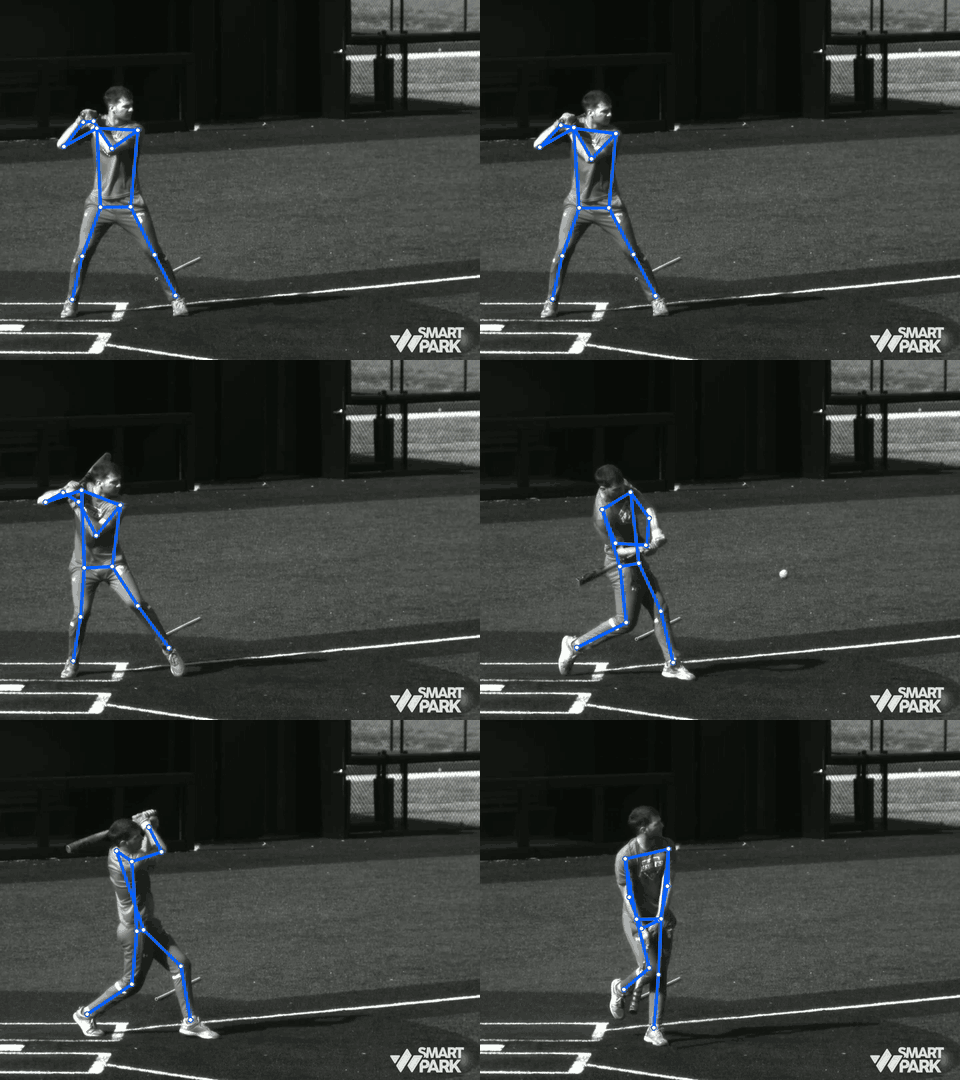
Every ball hit into fair territory at a SmartPark now comes with something it never had before: full swing biomechanics, captured automatically, on every single swing through SwingAI.
No tagging. No setup. No extra hardware. SwingAI is live, and it’s already running in the background of every game and practice your SmartPark records.
What’s New
SwingAI brings professional-grade swing analysis to the SmartPark ecosystem. The same biomechanical modeling technology behind WIN Reality’s hitting instruction is now capturing data automatically at the park.
Until now, getting this kind of insight meant dedicated capture systems, manual tagging, or other equipment that lived nowhere near a real game. SwingAI changes that. It runs quietly behind every at-bat, turning ordinary game and practice reps into a full biomechanical record without anyone having to do anything differently.
Why It Matters
Most tracking systems tell you what happened to the ball: exit velocity, launch angle, distance. SwingAI tells you why it happened: what the hitter’s body was doing in the tenths of a second that produced that outcome.
That’s the differentiator. Full-body swing mechanics, on every hit, all game long, with zero extra effort from players, coaches, or operators. It’s the kind of data depth that separates a SmartPark from every other tracking system on the market.
How It Works
SwingAI is automatically enabled at SmartPark sites equipped with SwingAI-aimed cameras, which is the vast majority of the parks. There’s nothing to configure and nothing to turn on. It’s already capturing data right now.
Where you’ll find it:
- SPO CSV exports — every hit, tagged or not, now includes SwingAI data appended to the standard SmartPark export.
- Mobile app — if you’re tagging hits from the mobile app, SwingAI data shows up there too.
Inside the Data: 24 Dimensions, 48 New Columns
SwingAI doesn’t just add a metric or two, it adds an entirely new layer to the SmartPark export. Every swing is now scored across 24 biomechanical dimensions, organized into six categories:
- Weight Shift & Stride — how a hitter loads and moves into the swing
- Pelvis — hip rotation through the load and into contact
- Upper Torso — shoulder rotation and direction at contact
- Hip-Shoulder Separation — the torque created between the hips and shoulders
- Posture — trunk tilt and body angle at key points in the swing
- Angular Velocity — how fast the pelvis, shoulders, and arm are rotating
- Center of Mass Distribution — how weight shifts from back to front through the swing
Each dimension appears in the CSV as two columns: the raw value and a WIN Score from 0–5, so you can see both the exact number and how it stacks up.
A quick note on scoring: 12 of the 24 dimensions (the “core” set) are scored today. The remaining 12 “extended” dimensions currently ship as raw data, with scoring on the way.
How a Swing Is Scored
Every scored dimension is graded on how close it sits to its optimal range:
- 🟢 Excellent (5) — inside the optimal range
- 🟡 Satisfactory (3–4) — a workable deviation, still effective
- 🔴 Out of Range (0–2) — a deviation big enough to cost performance
Availability
SwingAI is live now at SmartPark sites with SwingAI-aimed cameras (the large majority of parks). A small number of sites aren’t yet configured for it, but those will be updated in a future rollout.
Want the Full Breakdown?
Every dimension, every definition, and the full scoring methodology is documented in the SwingAI Biomechanics Guide.
Download the Metrics Guide (PDF) →
Or head to your SmartPark data now to see SwingAI in action:
[Placeholder: QUOTE]