You want more reps without turning your garage into a graveyard of gear you used twice. The fastest home setup is a tee, a 7×7 net, and a bucket of 12+ balls for daily contact work, then you upgrade with a swing trainer, a pitching/rebounder net, and one smart tool that trains timing and swing decisions.
That last piece is where most buyer’s guides fall short. A tee builds a repeatable move, but it never throws you a two-strike slider. This guide for the best baseball training equipment for home use ranks equipment by the skill it actually trains, the space it needs, and the feedback it gives you, so every dollar closes a real gap in your game.
What to Buy First
If you are building from zero, here is the direct answer by need.
- Essential home setup: batting tee + 7×7 hitting net + 12 to 24 practice balls. This handles daily contact and swing-shape work for under most equipment budgets.
- Best upgrade: a swing trainer for bat path plus a rebounder or pitching net with a strike-zone target for throwing and fielding reps.
- Best small-space option: a foldable net and a short tee station that fits a garage or driveway in under 5 minutes of setup.
- Best decision-training tool: VR pitch recognition. A tee cannot train pitch ID or timing against 85+ mph, and that is exactly the skill that transfers to games.
Every tool below fits into one of three buckets: physical reps, skill-specific upgrades, or decision reps and feedback. Build in that order and you will not waste money. Want the full room-by-room build? Start with how to build a baseball training setup at home.
Best Baseball Training Equipment for Home Use in 2026
A. Essential physical-rep tools: tee, net, balls, and a space-safe setup
Every good home hitter starts with 50 to 100 quality tee swings a day, and you cannot do that safely without three things.
- Batting tee: Look for adjustable height across the full zone (roughly knee to letters), a steel or heavy-rubber base for stability, and a flexible top that survives thousands of contacts. A stable tee lets you groove the same barrel path 50+ times without chasing it across the yard.
- Hitting net: A 7×7 net is the home standard. It absorbs full swings, folds for storage, and doubles for soft toss and front toss. A 7×7 footprint tells you the practice space you need: about 7 feet wide and tall, plus room to swing.
- Practice balls: Keep 12 to 24 on hand so you complete a full round without stopping. Mix real baseballs for feedback with foam or dimpled balls for indoor safety.
Use the tee to train the Swing Phase of your 4-phase sequence (Load, Stride, Swing, Finish) and to check barrel path on inside, middle, and away tee positions. If your barrel keeps leaking away from your body, that is casting, and the fix is the Stop at Contact Drill, not more random hacks.
Coach’s takeaway: Nail 50 clean tee reps a day this week, then add a net station so you can move to front toss. For indoor days, swap to foam balls and run these indoor baseball drills.
B. Skill-specific upgrades: swing trainers, rebounders, pitching targets, weighted balls, and cages
Once you own daily reps, buy the tool that matches your bottleneck, not the shiniest gadget.
- Swing trainers (bat path and connection): A rope-bat or connection-style trainer teaches “short to it, long through it” and keeps your hands connected to your turn. Use it for 2 sets of 8 to 10 dry swings before live reps.
- Rebounders (fielding and reaction): A rebound net fires the ball back at varying angles for solo grounders and quick-hands work. As Net World Sports notes, if you are looking to develop pitching and catching skills, then a rebound net is arguably the best piece of baseball training equipment you could buy.
- Pitching nets with strike-zone targets: A target trains command. Throw 20 to 30 pitches to spots and track how many hit the zone.
- Weighted balls (arm care and strength): Useful for building arm strength and sequencing awareness, but load carefully. Ramp slowly and cap volume, because high-rep weighted throwing raises injury risk for developing arms.
- Backyard cages and machines: A 22 to 55 foot cage or a soft-toss machine adds volume when you have the space and budget. Confirm your run length before buying, since a short cage limits full-speed machine work.
Coach’s takeaway: Pick one upgrade tied to your weakest skill this month. If your issue is low bat speed from poor separation, that is a mechanics fix (below), not a new bat.
C. Smart training tools: VR pitch recognition, swing feedback, radar, video, and sensors
Here is what a tee, net, and cage physically cannot do: throw you a live pitch you have to identify, time, and decide on. That is the skill that wins at-bats, and it is why smart tools belong in every 2026 setup.
- VR pitch recognition: A VR hitting simulator gives you game-speed at-bats against real pitchers at home, so the first time you see 90 mph in a game is your 100th time seeing it. This trains timing, pitch ID, and swing decisions that a tee never touches. See the full breakdown in VR training vs. the batting cage.
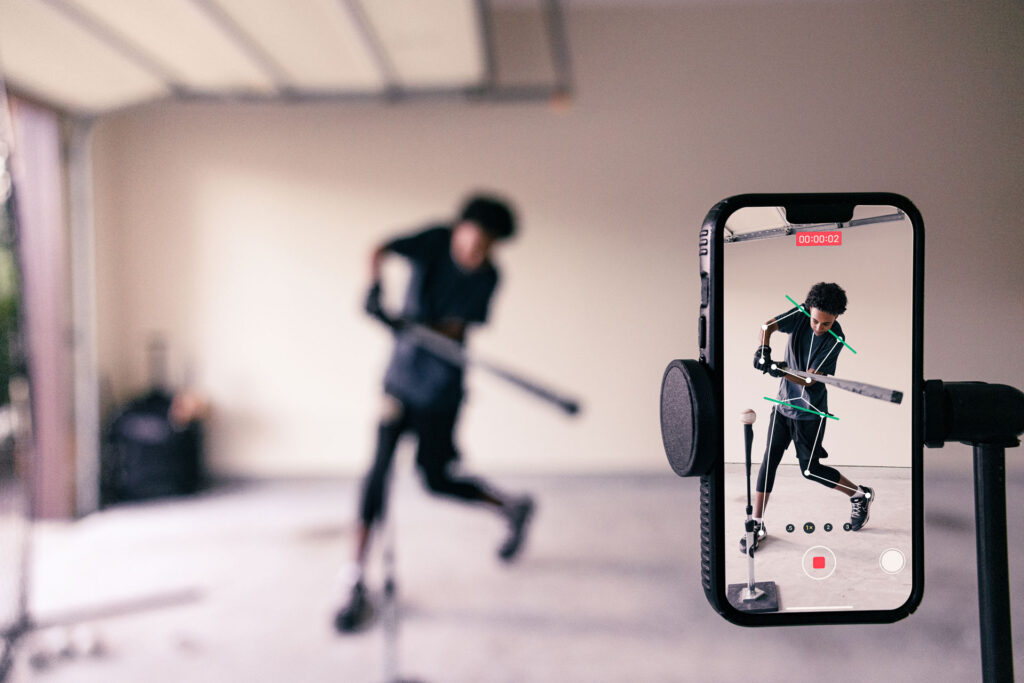
- AI swing feedback: Upload a swing video and get instant biomechanic analysis with personalized cues, so you are not guessing what to fix.
- Radar: Track exit velo and pitch speed to confirm whether an adjustment actually added output, not just felt better.
- Video and sensors: Slow-motion video and bat sensors give you frame-by-frame checkpoints on your Load, Stride, and contact positions.
The Three Pillars of Good Hitting are Bat Speed, Bat-to-Ball, and Swing Decisions. Physical-rep gear trains the first two. Smart tools are how you finally train the third at home. For a full rundown of software options, see the best baseball training apps for 2026.
Coach’s takeaway: Add one decision-training tool to your physical-rep setup. VR is the highest-transfer option because it trains timing and pitch recognition you cannot get off a tee.
Pair your tee and net with game-speed pitch recognition and AI swing feedback.
How to choose and use home baseball training equipment
Method 1: Buy by skill gap, not by gadget
Before you spend a dollar, name your bottleneck. Most hitters fall into one of these gaps.
- Low bat speed from poor separation: This is a hip-shoulder separation issue. Train it with the Torque Drill + Knob to Knee Drill, 2 sets of 4 reps per side, not random overload swings.
- Weak or inconsistent forward move, Sway, or Hanging Back: Run the Walk Through Drill to build a timed, controlled forward move (not a “weight transfer”).
- Casting / barrel leaking: Use the Stop at Contact Drill to keep the barrel tight to your turn.
- Bat-to-ball and contact quality: Tee, net, and front toss reps.
- Swing decisions and pitch ID: VR at-bats and live-pitch reps.
Match the tool to the flaw and you skip the clutter. If you cannot name your flaw yet, that is exactly what AI swing feedback is for.
Method 2: Build for your space: bedroom, garage, driveway, backyard, or cage
Your space decides your gear more than your budget does. Match the setup to what you actually have.
- Bedroom / apartment: Dry swings, a swing trainer, foam balls, and a VR headset. No ball flight needed, setup under 2 minutes.
- Garage: Foldable 7×7 net, tee, foam or dimpled balls, and a VR station. Watch overhead clearance for the finish.
- Driveway: Portable net and tee that break down in about 5 minutes, plus a rebounder for fielding.
- Small backyard: 7×7 net, tee, soft toss, and a pitching target on the fence.
- Large backyard / cage: Add a 22 to 55 foot cage and a machine for high-volume rounds.
Weather and setup time matter. If you lose 3 winter months outdoors, an indoor VR and swing-trainer plan keeps your reps year-round. More options in this batting cage alternative at home guide.
Method 3: Track feedback and game transfer
Reps only count if they move a number. Do not just pile up swings, measure whether the gear is working.
- Contact quality: Chart hard-hit rate off the tee and in toss, aiming for line drives on 7 of 10.
- Bat speed and exit velo: Log radar readings monthly and look for real gains, not one-day spikes.
- Swing decisions: Track chase rate and take/swing decisions in VR at-bats.
- Mechanics: Re-shoot your swing video every 2 weeks and compare the same checkpoints.
- Game transfer: Watch your two-strike results. League average drops to .165 with two strikes, and cutting swing-and-miss can add 15 to 20 hits over a season.
Remember that mechanics and mental approach work together. A hitter thinking about mechanics in the box usually freezes, so use your home reps to make the move automatic, then compete and trust it in the game.
Coach’s takeaway: Pick two metrics, log them every 2 weeks, and cut any tool that does not move them.
How WIN Reality helps: TrainVR, SwingAI, and home player development
Your tee and net build the move. WIN Reality builds the decision and the feedback loop around it, which is the exact gap generic gear lists miss.
TrainVR is a Meta Quest VR hitting simulator that puts you in game-speed at-bats at home. It includes:
- 600+ virtual pitchers and support for both baseball and softball pitching. [NEEDS VERIFICATION: confirm pitcher count against current approved product documentation]
- Drills like Pitch Recognition, Release Point, Disappearing Pitch, Recognition Window, Batting Practice, and Exhibition Mode. [NEEDS VERIFICATION: confirm all drill and mode names against current approved product documentation]
- Scenario workouts for breaking-ball recognition, 3-2 counts, 0-2 and 2-strike approach, moving runners, fastball/curveball tunneling, and opposite-field power. [NEEDS VERIFICATION: confirm all scenario workout names against current approved product documentation]
- Multi-week Training Tracks so your reps build on each other.
Explore it at TrainVR. This is how you train timing and swing decisions a tee never can.
SwingAI closes the mechanics loop. Upload a swing video, get instant AI biomechanic analysis, and receive personalized cues and an improvement plan with unlimited analyses and progress tracking. It scores 12 biomechanical dimensions across Balance & Load, Stride, Power Move, and Contact, including Pelvis Load, Hip Shoulder Separation at Foot Down (X-Factor), and Forward Move. See it at SwingAI.
Want both plus the hardware? The Ultimate Hitter Pack bundles TrainVR, SwingAI, and the WIN bat attachment, with an optional Meta Quest headset. WIN Reality offers promotional pricing on annual bundle subscriptions, but discount figures change seasonally. Confirm the live rate for your plan at the bundle page before you check out.
Build a complete home training system with WIN Reality
Stack it in order: daily tee and net reps for contact, a swing trainer or rebounder for your specific gap, then TrainVR and SwingAI for the timing, pitch recognition, and swing feedback that actually transfer to games. That is a complete home system, not a pile of gear. Train the decision, not just the swing.