Why Batting Average Drops
You hit .400 in travel ball, then your average cratered your freshman year. That is not a talent problem. It is what happens when the game speeds up all at once.
High school baseball throws four new challenges at you simultaneously: fastballs that jump from the low 70s to the mid 80s, actual breaking balls, a BBCOR bat that kills the trampoline effect you got from your old USSSA barrel, and infielders who turn your hard grounders into outs.
Most high school coaches have 90 minutes, one cage, and a roster of 15 to 18 players with wildly different skill levels, as outlined in WIN Reality’s high school hitting development plan.
The fix is not swinging harder or “seeing the ball better.” It is diagnosing which measurable input is dragging your average down, then training that input at game speed.
Four Skills That Raise Batting Average in High School Baseball
To raise your batting average, stop chasing the number and start improving the four inputs that produce it: swing decisions, contact quality, timing, and pitch recognition. Get those right and hits follow.
Here is what that looks like in practice:
- Swing at better pitches. Cut your chase rate. Hitters who expand the zone before two strikes give away at-bats.
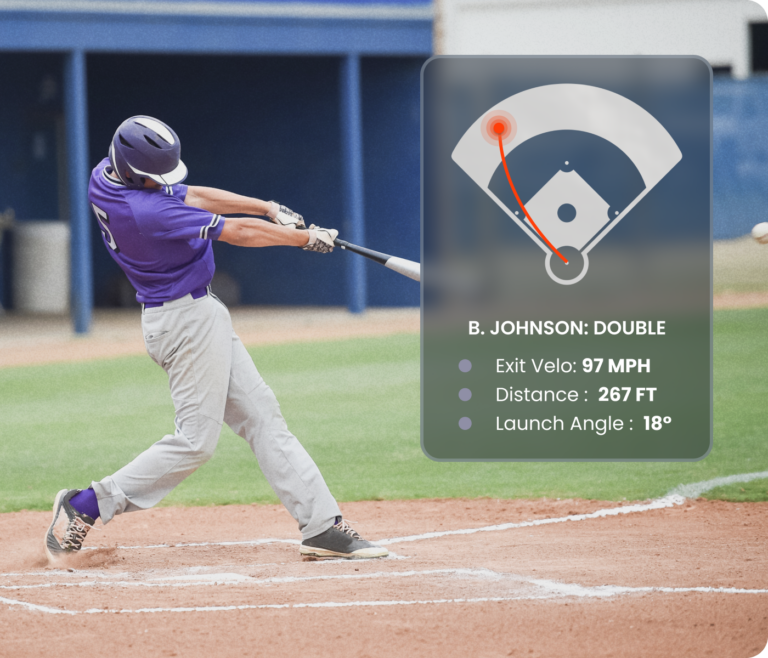
- Hit the ball harder, on a line. According to WIN Reality’s exit velocity breakdown, MLB Statcast data shows that when a ball is hit at 96 mph or higher, batting average jumps above .300, and dropping just 1 mph to 95 drops it to .265. Exit velo turns near-outs into hits.
- Be on time. Late timing produces rollovers, pop-ups, and weak fly balls no matter how good your mechanics look in the cage.
- Recognize pitches early. You cannot square up a slider you read as a fastball.
Batting average is an outcome, and a small, noisy sample influenced by defense, luck, and scorekeeping. That is why smart hitters track the inputs underneath it: contact rate, chase rate, hard-hit rate, line-drive rate, and quality at-bats. Fix the inputs and the average climbs on its own.
Diagnose Why Your Batting Average Is Low Before Changing Your Swing
Most hitters respond to a slump by rebuilding their swing. That is a mistake. Plenty of low averages come from decisions and timing, not mechanics.
Before you touch your swing, figure out which of these is actually happening in your at-bats. This is the WIN Reality framework built on the Three Pillars of Good Hitting: Bat Speed, Bat-to-Ball, and Swing Decisions. Run the diagnostic first, then treat the real problem.
A. Swing Decisions: Chase Rate, Hitters’ Counts, and Pitch Selection
Watch a full week of your at-bats and count how often you swing at pitches outside the zone. If you are chasing more than 1 in 4 sliders in the dirt, your average is capped no matter how pretty your swing is.
The two biggest decision leaks in high school:
- Expanding the zone before two strikes. You get one good pitch to hit per at-bat. Fouling it off or chasing junk hands the count to the pitcher.
- Passing up hitters’ counts. In 2-0, 3-1, and 2-1, pitchers throw fastballs in the zone at a much higher rate. If you take those to “see one,” you are giving away your best swing.
As WIN Reality’s high school hitting guide emphasizes, high school hitting should prioritize swing decisions, pitch recognition, timing, and quality contact, not just mechanics. Start by narrowing your zone: hunt one location early, and only expand with two strikes. That single change can add points fast because you stop making outs on pitches you were never going to barrel.
B. Contact Quality: Exit Velo, Line Drives, Rollovers, and Pop-Ups
You can make contact and still hit .220. If every ball is a rollover to short or a lazy pop-up, contact is not your friend.
Weak contact usually traces to a mechanical leak you can name and fix:
- Rollover grounders and casting mean your barrel leaks away from your body too early. The WIN cue is “short to it, long through it,” and the fix is the Stop at Contact Drill.
- Pop-ups and getting under the ball often come from hanging back or a weak forward move. Fix it with the Walk Through Drill and the cue “land firm, turn behind your front hip.”
- Not enough exit velo frequently comes from poor hip-shoulder separation, which robs bat speed. Build it with the Torque Drill plus the Knob to Knee Drill, not generic “swing harder” reps.
Check your exit velocity against your age group to know whether power is really the issue. A 70 mph line drive beats a 90 mph pop-up every time. Prioritize repeatable hard contact on a line over one loud number.
C. Timing and Recognition: Velocity, Breaking Balls, and Off-Speed Adjustments
Here is the one that quietly wrecks freshmen and sophomores. You looked great in the cage against 60 mph front toss, then faced 82 in a game and got beat by every fastball. That gap between cage swings and live at-bats is the number one complaint high school hitters have, and it is real.
The math explains it. As detailed in WIN Reality’s VR training research, an above-average 14U pitcher throwing approximately 70 mph gives hitters only 0.59 seconds to react, while an outstanding 75 mph pitcher cuts that window to 0.55 seconds. At varsity velocity, that window shrinks further.
Two things break down at game speed:
- Recognition. You need to read pitch type out of the hand from spin and release, not halfway to the plate. If you are picking up a curveball too late, you either take a strike or roll over it.
- Timing. If your load and stride are not on time at foot down, your swing arrives late even when your mechanics are clean.
This is a training-transfer problem, and it is why grooving swings off a tee will not save you. You need reps against game-speed pitching, with real breaking balls and off-speed mixed in, so recognition and timing become automatic.
See more pitches, make smarter decisions, and train the timing that transfers to Saturday. Get started with WIN Reality.
Tools and Methods: Three Ways to Raise Batting Average With Metrics
You have limited practice time, especially in-season. These three methods target the inputs that actually move your average, so every rep earns its spot.
Method 1: Track the Stats That Predict Better At-Bats
Batting average lies in small samples. Ten at-bats can swing your average 100 points on defense and luck alone, which is why experienced coaches stop ranking hitters by it. Track the inputs that stabilize faster and tell you what to fix:
- Contact rate: how often you put the barrel on the ball when you swing.
- Chase rate: how often you swing at pitches outside the zone. Aim to trend it down every week.
- Hard-hit rate and line-drive rate: your share of balls hit hard and on a line.
- Strikeout rate: especially two-strike punchouts.
- Quality at-bats (QABs): hard contact, a walk, a 6-plus pitch battle, or a productive out.
- Performance against better pitching: how you do against the top arms, not the bottom of the schedule.
When these numbers climb, your average follows even before the box score catches up. Pick two to track this month and review them weekly.
Method 2: Build a Count-Based Plate Discipline Plan
Random aggression makes outs. A count-based plan turns each at-bat into a decision tree you have already rehearsed. Two things matter every pitch: did you swing at a good pitch, and were you on time?
Your plan:
- 0-0 to 1-1: Hunt one zone. Swing only if the pitch is in it. Take everything else.
- Hitters’ counts (2-0, 3-1, 2-1): Sit fastball in your zone and drive it. This is your green light.
- Two strikes: Widen your zone, choke up slightly, shorten your swing, and battle. As WIN Reality’s high school hitting framework recommends, prioritize contact and fighting off tough pitches.
The two-strike piece is worth real points. League average collapses to roughly .165 with two strikes, and cutting your swing-and-miss in that count alone can produce 15 to 20 more hits over a season. Rehearse each count until the decision is automatic, so you are never thinking mechanics in the box.
Method 3: Make Batting Practice Look More Like High School Games
Grooving 40 swings against soft front toss feels productive and rarely transfers. If your BP does not look like a game, it will not prepare you for one.
Rebuild your reps around game speed and decisions:
- Add velocity and recognition rounds. Face pitches that force you to read type and location, not just react to a groove.
- Track breaking balls. Take rounds where you only swing at strikes and label each pitch out loud.
- Run situational rounds. Include moving a runner over with a swing or a bunt, and getting a runner in from third, as outlined in WIN Reality’s expert hitting tips.
- Compete. Keep score in BP so reps carry game pressure.
Use WIN Reality’s guide on how to run effective batting practice to build goal-driven rounds with 6 to 12 quality swings each, so no rep is wasted. In-season, quality beats volume every time.
How WIN Reality Helps: Train the Skills Behind a Higher Batting Average
You cannot see 200 game-speed pitches a night in a cage, and your coach cannot manufacture them in a 90-minute practice. WIN Reality’s product ecosystem is built to close exactly that gap, at home, on your schedule.
TrainVR puts you in the box against real pitching without a live arm. With age-appropriate stadiums, mound distances, and a 600+ pitcher library, WIN Reality drives results for players just getting started up to MVP winners in the majors, as detailed on the TrainVR product page. It trains the inputs behind your average:
- Game-speed pitch recognition through Pitch Recognition, Release Point, and Disappearing Pitch drills.
- Plate discipline and swing decisions through scenario workouts like 0-2 approach, 3-2 counts, and breaking ball recognition.
- Virtual at-bats and Exhibition Mode so timing and recognition transfer to the game.
The volume is the point. Hitters can take 100-plus virtual at-bats against 600-plus pitchers at home, without burning cage time or a pitcher’s arm. According to WIN Reality’s hitter development research, using WIN for just 15 minutes a day helps players develop skills like plate discipline 7 times faster than those who don’t, and it compounds.
SwingAI handles the mechanical side. You upload a swing video and get instant AI biomechanic analysis across 12 dimensions, with personalized cues and an improvement plan so you fix the Load, Stride, Swing, and Finish leaks producing weak contact, not guess at them. Learn how each tool fits daily development in WIN Reality’s VR training effectiveness research, and check your exit velocity benchmarks by age to set a real target.
The Ultimate Hitter Pack bundles TrainVR and SwingAI with a WIN bat attachment and an optional Meta Quest 3S headset at a significant first-year discount when purchased with hardware. For the full picture of what “good” looks like at your level, the MLB Statcast glossary defines batting average and the metrics that surround it.
Explore the TrainVR and SwingAI product pages to build your plan.
Start Raising Your Average Today
Your batting average will not climb because you stared at it longer. It climbs when you swing at better pitches, hit the ball harder on a line, and show up on time against real velocity. Train those inputs 15 minutes a day and let the number take care of itself. Get started with WIN Reality.